
How to Triage a Plumbing Call in Under 90 Seconds: A Field Guide for Solo Operators
The first 90 seconds of a plumbing call decide whether you book the job, waste a truck roll, or lose it entirely. Here's how to triage like a pro.
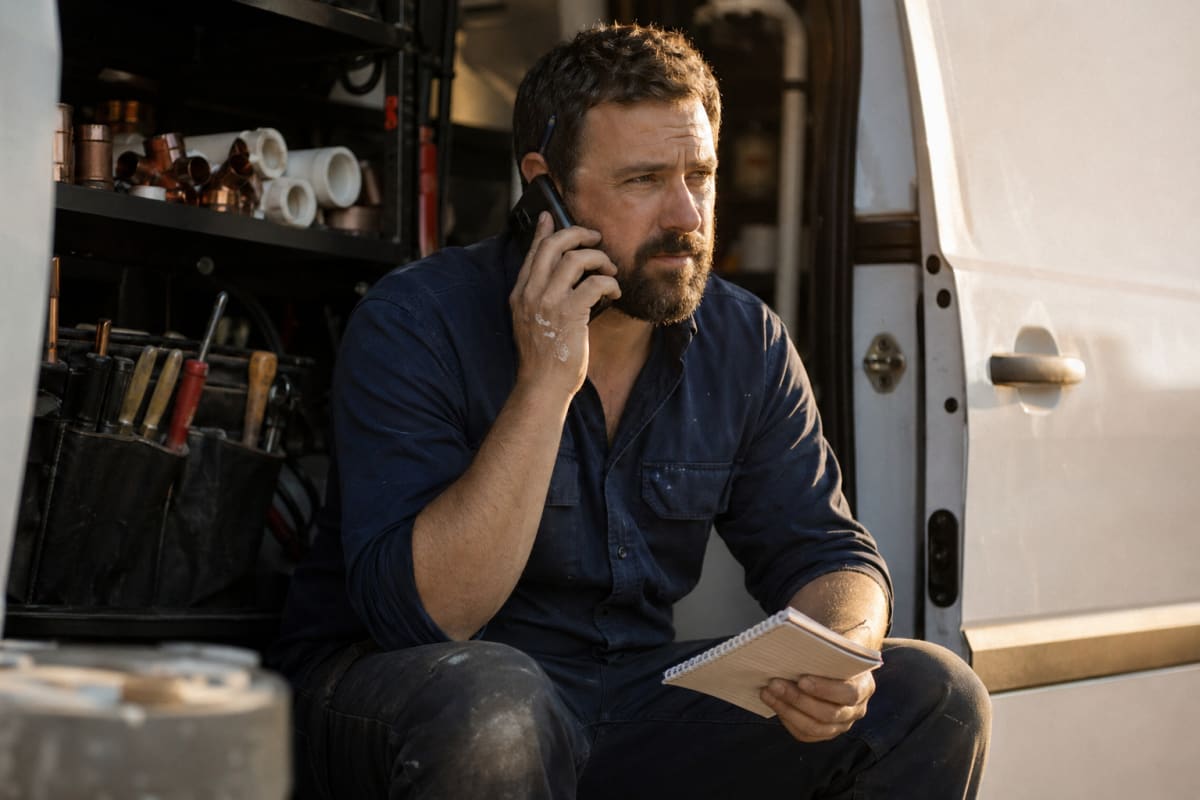
The phone rings. Someone says, "I have a leak."
What's your next sentence?
If you're like most plumbers, the answer is "Where are you located?" or "When can I come out?" — and that's the first mistake. Both are scheduling questions. They tell you where to drive, but they don't tell you whether the caller's house is going to be three inches deep in water by the time you get there.
The job in the first 90 seconds of a plumbing call isn't to schedule. It's to triage — to figure out, fast, whether you're dealing with an active emergency, a same-day urgency, or a routine job that can wait until Tuesday. The plumbers who triage well book more jobs, drive less wasted miles, and don't wake up at 2 AM for a slow drip that could've waited.
Here's how to do it in under 90 seconds.
Why triage matters more than scheduling
Two failure modes cost plumbers real money:
Failure 1 — Treating a routine call like an emergency. You roll a truck out at 11 PM for a "leak" that turns out to be a slow drip the homeowner has lived with for three weeks. You burn $200-$400 in premium labor for a job that should have been a Tuesday-morning appointment.
Failure 2 — Treating an emergency like a routine call. You tell the homeowner you'll see them at 9 AM tomorrow. They call the next plumber on Google because their basement has six inches of water. You lose a $1,500 emergency job and the future water heater replacement and the referral to their neighbor.
Both failures come from the same root cause: not asking the right questions in the first 30 seconds.
The first question that changes everything
There's one question you should ask before anything else, on every plumbing call where water is involved:
"Is the water shut off?"
That single question does four things at once:
- It tells you the severity. If the water isn't shut off and the leak is active, you know immediately whether you're rolling a truck right now or scheduling for tomorrow.
- It gives the homeowner an action. People in crisis want to be told what to do. "Find your main shut-off and turn it clockwise" gives them a job that reduces panic and damage at the same time.
- It demonstrates competence in five words. You sound like a professional, not a script-reader. The homeowner relaxes.
- It buys you time to think. While they're walking to find the valve, you're calculating travel time and inventory.
If the answer is "yes, the water is shut off" — you have time. Schedule the job intelligently.
If the answer is "no, water is still flowing" — you're in an emergency. Skip every other question except the address.
The three-tier triage framework
Every incoming plumbing call falls into one of three tiers. Your goal in the first 90 seconds is to figure out which tier you're in.
Tier 1: Active emergency (truck rolls now)
These are calls where damage is happening right now or safety is at risk. Drop everything.
- Active flooding — water flowing where it shouldn't, faster than the homeowner can contain
- Burst pipe with main valve unable to stop the flow (broken valve, frozen line that's also broken)
- Sewage backing up into the home, especially through multiple drains
- No water at all in the house (frozen line, broken main, no hot water in winter for vulnerable households)
- Any gas smell — though that's a 911 / utility company call, not yours
- Water near electrical panels, fixtures, or outlets
For these calls, your only job in the first 60 seconds is to: get the address, give shut-off instructions if applicable, quote your emergency dispatch fee, and confirm an ETA. Save the diagnostic questions for when you arrive.
Tier 2: Same-day urgency (book for today)
These are real problems, but the damage is contained or there's no immediate damage at all. The homeowner needs help today, not in three days, but it can wait two to four hours.
- Slow leak that's been caught early and isn't spreading
- Clogged main line where one toilet still works
- Water heater failure with no leak (cold showers, but the house isn't flooding)
- Sump pump failure during dry weather
- Single fixture not working when others are fine
These are good jobs. They convert to scheduled appointments at standard rates and they fill out your day. Don't blow them off, but don't roll a truck at 1 AM for them either.
Tier 3: Routine scheduling (book for next available)
These are jobs that can wait until your normal hours without anything getting worse.
- Quotes on water heater replacements, repipes, fixture upgrades
- Slow drains that have been slow for weeks
- Dripping faucets and running toilets where the bill is the only damage
- Annual maintenance, inspections, drain cleanings
- Estimate requests for remodels and additions
These are also good jobs — sometimes great ones — but they don't earn premium rates. Schedule them for normal business hours and don't burn weekend labor on them.
The 90-second triage script
Here's the actual flow — what to ask, in what order, to figure out which tier you're in without keeping the homeowner on the phone forever.
| Seconds | What to do | Why |
|---|---|---|
| 0-5 | "Hi, this is [name] at [company]. What's going on?" | Open with empathy, not scheduling. Let them describe the problem in their own words. |
| 5-20 | Listen. Don't interrupt. | Most homeowners volunteer the critical information (active water, panic, timing) in the first 15 seconds if you let them. |
| 20-30 | "Is the water shut off right now?" | The single highest-leverage question on any water-related call. |
| 30-50 | If active: "Where's the water coming from? How fast?" If contained: "When did you first notice it?" | Volume + timeline = severity. "Water everywhere" from a panicked homeowner could mean two gallons or two hundred. |
| 50-70 | "What's your address?" plus one or two specific diagnostic questions for the problem type (see below). | Get enough info to dispatch with the right parts. Not a full diagnosis. |
| 70-90 | Quote the dispatch fee or appointment time. Confirm the next step. | Always tell them what happens next — "I'll be there in 45 minutes," "I have you booked for 9 AM tomorrow," etc. |
If you're past 90 seconds, you're over-qualifying. The remaining details can wait until you're on-site.
Quick diagnostic questions by problem type
For each common call type, there's one or two follow-up questions that materially change how you dispatch.
Active leak / burst pipe - "Where is the water coming from? Wall, ceiling, fixture, floor?" - "Is it hot or cold water?" (hot suggests water heater or supply line; cold could be anywhere)
Water heater - "Gas or electric?" - "Is it leaking, or just no hot water?" - "How old is the unit?" (anything over 10 years is replacement territory)
Clog or backup - "Just one fixture, or multiple drains?" (multiple = main line, much bigger job) - "Any sewage smell or backup into other drains?"
Sewer line - "Is anything backing up into the lowest fixtures — basement floor drain, shower, toilet?" - "Any soggy patches in the lawn?" (root intrusion / line break)
No water - "Is it the whole house, or just one fixture?" - "Did anything change recently — frozen weather, recent work done, neighbors affected?"
These are not full diagnostic interviews. They're the one or two questions that tell you what truck stock to bring and how urgent the dispatch is.
The mitigation step that earns trust
For any active-water emergency, give the homeowner one mitigation instruction before you hang up:
- Active leak → "Find your main shut-off valve and turn it clockwise." (Most are near the water heater or where the main enters the house.)
- Sewage backup → "Don't run any more water in the house until I get there. Stop using sinks, showers, dishwashers."
- No hot water with leak → "Turn off the water supply line going into the heater — there's usually a valve right above it."
- Frozen pipe (not yet burst) → "Open a faucet on the affected line just a trickle, and don't apply heat until I'm there to assess."
Two things happen when you do this. First, real damage gets reduced — the gallon-per-minute leak becomes a contained mess instead of a flooded basement. Second, the homeowner gives you a level of trust that's almost impossible to earn any other way. You've helped them before you've charged them. They're not calling the next plumber on Google after that.
Why this is harder than it sounds for solo operators
Reading this guide and running this guide are two different things.
The reality is that you're not always available to triage calls in real time. You're under a sink. You're driving. You're in a basement with no signal. You're asleep at 11 PM. The 90-second triage script only works if there's someone picking up the phone in the first place — and for most solo plumbers, that's the bottleneck.
There are three real ways to make sure the triage actually happens:
- Take the call yourself, every time. Possible in theory. In practice, you'll miss 20-30% of calls and burn out within six months trying not to.
- Hire a human dispatcher. Works above a certain volume — typically once you're booking 10+ jobs a day. Below that, the math doesn't pencil out: $3,000-$5,000/month in salary against the marginal jobs you'd have lost otherwise.
- Use a system that runs the triage for you. A modern AI receptionist can run this exact script — ask if the water's shut off, classify the tier, give mitigation instructions, transfer real emergencies to your phone, and book Tier 2 and Tier 3 calls into your calendar. The technology has matured to the point where most callers can't tell they're not talking to a person, and the cost is a fraction of a human dispatcher.
The math from the cost-of-missed-calls analysis and the speed-to-lead research only works if someone — human or otherwise — is actually triaging the calls. Speed without triage means you waste truck rolls. Triage without speed means the caller already booked the next plumber. You need both.
What good triage actually buys you
Solo plumbers who run a real triage system on every incoming call see three measurable changes within a few months:
- Higher revenue per call. Tier 1 calls get charged emergency rates ($200-$400 dispatch fee plus labor). Tier 2 and Tier 3 calls don't get accidentally treated as emergencies, so you don't undercharge for them either.
- Fewer wasted truck rolls. The slow-drip-for-three-weeks call gets scheduled for Tuesday instead of pulling you out of bed Saturday night.
- Better conversion on the calls that matter. Industry research on emergency calls shows that customers convert to paid jobs at 60-70% when handled well, versus the 30% conversion rate on routine calls. The triage step is what separates the two.
If you want to hear what the 90-second triage script sounds like in practice — done well — dial (947) 221-1601. That's our demo line, answering as a fictional plumbing company called McKinney Elite. Tell it you have a leak. Listen for what it asks first.
If the first question isn't "Is the water shut off?" — keep shopping for receptionists. If it is, you've heard what good triage sounds like.
HiRiley is a 24/7 AI receptionist built for plumbers and other local service businesses, starting at $29/month with a free trial that doesn't require a credit card. Real triage. Real speed. Built for the trade.
Try Riley
Stop missing calls.
10 free calls. No credit card. Live in under five minutes.
Keep reading
The First 90 Seconds of a Water Damage Call: What Restoration Companies Need to Capture Fast
Water damage callers are panicking as they dial — and the next 90 seconds decides whether…

The Busy-Season Phone Trap: How Landscapers Lose Quote Requests While They're on a Mower
Landscapers miss 74% of calls during spring rush — the highest rate in the trades — becau…
Emergency or Estimate? How Electricians Can Triage Calls in Under Two Minutes
Electrical triage is harder than other trades because the consequences of getting it wron…