
The Real Cost of a Missed Call: What Voicemail Is Quietly Costing Your Plumbing Business
Most plumbers underestimate how much voicemail costs them. Here's the real math, with three scenarios — and four honest ways to plug the leak.
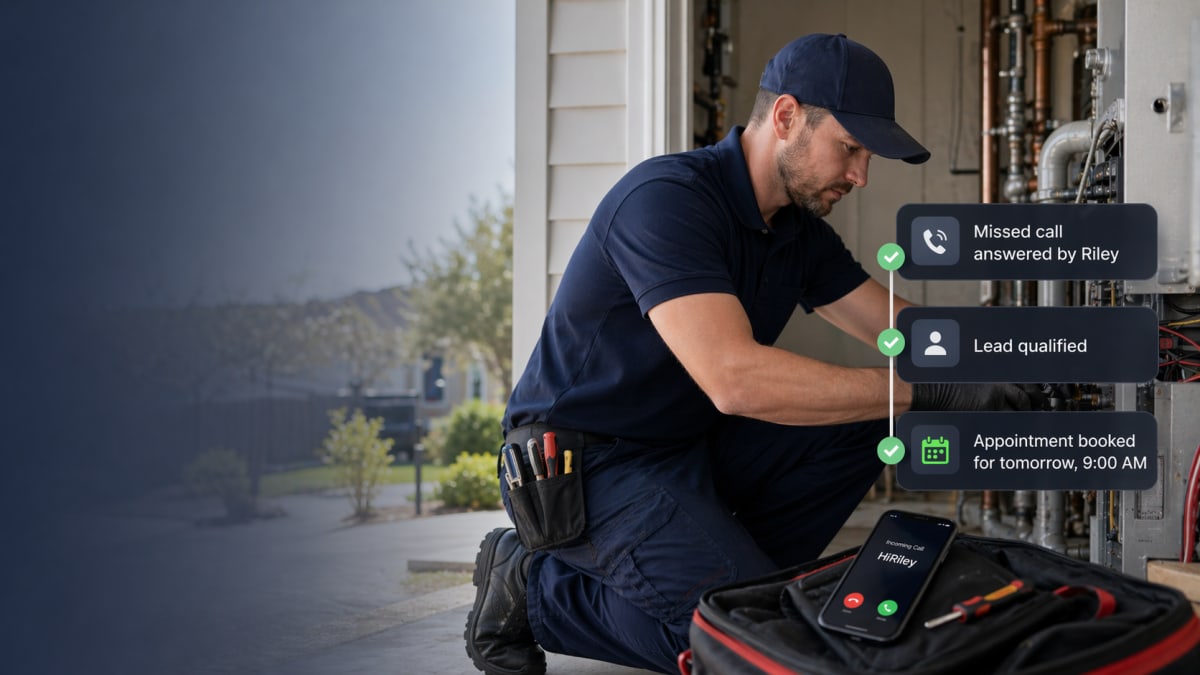
You're under a sink with pipe dope on your hands when your phone rings.
By the time you've finished tightening the fitting, wiped your hands, and pulled your phone from your pocket, the call has gone to voicemail. You check the screen — unknown number. You hit callback. It rings four times. No answer.
That homeowner already called the next plumber on Google.
This isn't a story about working harder. You're already working hard. It's a story about a small leak in the side of your business that drips revenue every single day — quietly, predictably, and in amounts that would shock you if you ran the numbers.
So let's run them.
The five-minute calculation every plumber should do this week
Open your phone log. Look at the last seven days. Count the incoming calls you didn't answer — the ones that went to voicemail, the ones from numbers you didn't recognize, the ones you saw two hours after the fact when you got back to your truck.
That's your weekly miss rate.
Now grab three numbers from your last month of work:
- Average job value. Total what you've billed over the last 30 days, divide by the number of jobs you completed. For most residential plumbers this lands somewhere between $300 and $800.
- Conversion rate on answered calls. Of the people who do reach you, what percentage actually book? Most plumbers convert 30–40% of inbound calls into paying jobs.
- Hang-up rate. Industry research suggests roughly 85% of callers who hit voicemail never leave a message — they just hang up and dial the next listing. That number rises to 95% for after-hours emergencies.
Now multiply:
Missed calls per week × hang-up rate × conversion rate × average job value × 52 weeks = your annual leak
Three quick examples will show you what this means in practice.
What the math looks like for real plumbers
Scenario 1 — The "I don't think I miss that many" plumber
You think you only miss two or three calls a week. Maybe you do. Let's run the conservative version.
| Metric | Value |
|---|---|
| Missed calls per week | 3 |
| Hang-up rate | 85% |
| Conversion rate on answered calls | 30% |
| Average job value | $400 |
| Annual revenue leak | $15,912 |
Three calls a week. That's it. And the cost is roughly the equivalent of replacing your work truck every five years — except instead of a truck, you got nothing.
Scenario 2 — The typical solo plumber
You take most calls when you can but you're under sinks and on roofs and driving between jobs. Realistically, you miss one a day during the week and three or four over the weekend.
| Metric | Value |
|---|---|
| Missed calls per week | 8 |
| Hang-up rate | 85% |
| Conversion rate on answered calls | 35% |
| Average job value | $500 |
| Annual revenue leak | $61,880 |
This is the number that makes most plumbers stop and stare at the screen. Sixty thousand dollars. That's a full-time apprentice you could afford to hire if the calls weren't slipping.
Scenario 3 — The busy shop with weekend emergencies
You handle a healthy mix of routine calls and after-hours emergencies. Water heater replacements ($1,500–$3,500) and burst-pipe weekends pull your average ticket up.
| Metric | Value |
|---|---|
| Missed calls per week | 10 |
| Hang-up rate | 85% |
| Conversion rate on answered calls | 35% |
| Average job value | $750 |
| Annual revenue leak | $116,025 |
At this point we're not talking about a leak. We're talking about a hole. And the worst part is that none of these scenarios account for lifetime value — the homeowner who would have called you back next year for the water heater, and the year after for the bathroom remodel, and who would have referred their neighbor.
When a missed call walks, that whole future walks with it.
What the industry data actually shows
If you don't trust your own seven-day count, the broader research backs up these numbers:
- Housecall Pro's contractor research has pegged the average value of a single missed call at roughly $1,200 in lost revenue once you factor in lifetime customer value.
- Inbound-call analytics firms have measured that around 28% of calls to local service businesses go unanswered during business hours. After hours, that number can climb past 90%.
- Studies of speed-to-lead consistently show that the first business to answer wins the job somewhere between 60% and 80% of the time, especially when there's an active emergency on the other end of the line.
- Roughly 95% of after-hours callers hang up rather than leave a voicemail, and only about 5% will wait for a callback the next morning.
The conclusion every credible source arrives at is the same: missed calls are the largest, most overlooked source of revenue loss in residential plumbing — and the gap between what you think you're missing and what you're actually missing is almost always wider than expected.
Why "just answer more calls" doesn't work
Most plumbers, when they finally see the number, react the same way: I just need to be better about answering the phone.
That fix lasts about three days.
The reason isn't willpower. It's physics. You cannot answer the phone when:
- Your hands are wet, greasy, or holding a wrench
- You're in a basement, crawl space, or mechanical room with no signal
- You're already on a call with another customer
- You're driving with both hands on the wheel
- It's 11 PM and you're asleep
- You're in the middle of explaining a quote to the homeowner standing in front of you
These aren't excuses. They're the actual conditions of doing the work. A solo plumber who tries to personally answer every call ends up doing one of three things: missing calls anyway, dropping quality on the job in front of them, or burning out within six months.
The system is the problem. The fix has to be a system.
The four real options, ranked honestly
There are four ways to plug the leak. Each one has a different cost, a different setup, and a different ceiling on how much revenue it actually recovers.
Option 1: Voicemail with a callback promise
Cost: free. Recovery rate: roughly 5% of missed callers. This is what you have today, and what the math above is built on. It's the baseline you're trying to beat.
Option 2: Missed-call text-back
When you miss a call, the system automatically sends the caller a text: "Sorry I missed you, I'm on a job — what's the issue?" Cost runs about $50–$100/month. Recovery rate is meaningfully better than voicemail because most people will text back, but it still puts the burden on the homeowner to wait, and emergency callers won't. Best for non-urgent overflow.
Option 3: Human answering service
A real receptionist at a call center picks up. Cost typically runs $300–$600/month with per-minute overages, often more for after-hours coverage. Recovery is high, but you pay the same rate whether the call is a $3,000 water heater job or a wrong number. Setup involves training the agents on your services and pricing. Best for high-volume shops where the price-per-call still pencils out.
Option 4: AI receptionist
A trained voice agent answers in under two seconds, qualifies the call, captures address and problem, identifies emergencies, and either books the job or transfers urgent calls to your phone. Modern systems sound natural enough that most callers don't realize they're talking to AI. Cost typically runs $29–$200/month flat for small operators — no per-call fees, no overages. Setup takes minutes, not days. Best for solo operators and small shops who need the recovery rate of a human service at a price that makes sense for one or two trucks.
The honest tradeoff
No solution recovers 100% of missed calls. Some emergencies are so urgent that the caller hangs up before any system answers. Some homeowners will only talk to a human. Some calls really aren't worth recovering — wrong numbers, telemarketers, price shoppers calling every plumber in the city.
But here's the thing: even a 50% recovery rate against the Scenario 2 numbers above is a $30,000 swing in your favor. Against Scenario 3, it's nearly $60,000. The cost of any of these solutions — even the most expensive human answering service — is a rounding error against what you're losing.
The question isn't whether to fix the leak. It's which patch fits your situation.
Where to start this week
If you do nothing else after reading this, do these three things:
- Pull your phone log for the last seven days and count the misses. Don't estimate. Count.
- Calculate your annual leak using the formula at the top of this post and your real numbers. Write the number down somewhere you'll see it.
- Pick one solution to test — even just a missed-call text-back is a starting point. Run it for 30 days and measure how many of those captured leads turn into booked jobs.
You don't have to solve this perfectly. You just have to solve it better than voicemail. Because every week you wait, the leak keeps dripping.
HiRiley is a 24/7 AI receptionist built for plumbers and other local service businesses, starting at $29/month with a free trial that doesn't require a credit card. If you want to hear what a Riley call sounds like before you sign up for anything, dial (947) 221-1601 — that's a real demo line answering as a fictional plumbing company. Ask about a water heater, an emergency leak, or anything else you'd hear on a normal day. The whole point is that you can hear it for yourself before you decide.
Try Riley
Stop missing calls.
10 free calls. No credit card. Live in under five minutes.
Keep reading
The First 90 Seconds of a Water Damage Call: What Restoration Companies Need to Capture Fast
Water damage callers are panicking as they dial — and the next 90 seconds decides whether…
Storm Damage Calls Don't Wait: How Roofers Capture Leak and Hail Leads Before the Next Contractor
Roofers miss 50-70% of calls during post-storm surges, when 48 hours decides 6 months of …

How Real Estate Agents Lose Buyer Leads in the First 90 Seconds (and How to Be the One Who Doesn't)
NAR data shows 78% of homebuyers work with the first agent who responds to their inquiry.…