
Emergency or Estimate? How Electricians Can Triage Calls in Under Two Minutes
Electrical triage is harder than other trades because the consequences of getting it wrong include house fires. Here's a four-tier framework that runs in under two minutes.
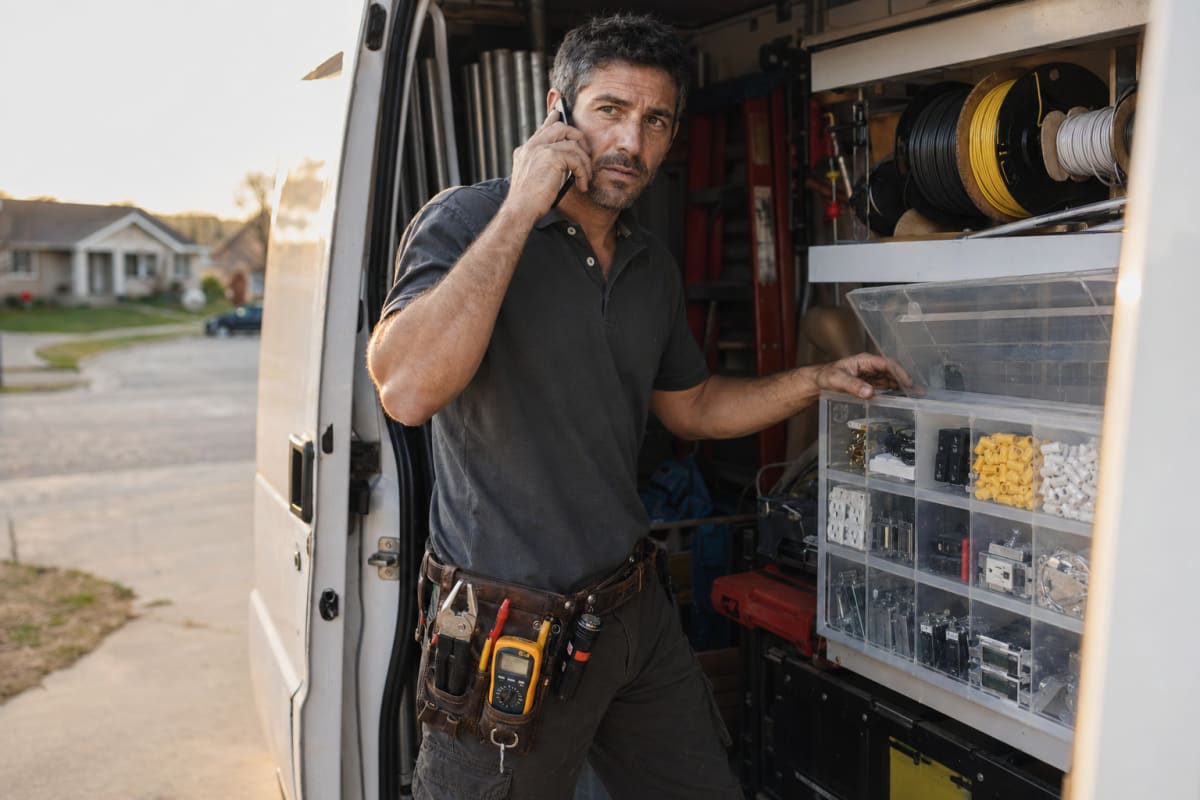
The phone rings. A homeowner is on the line, and they're saying "my outlet is sparking."
What's your next sentence?
If your answer is "when can I come look at it?" — that's the wrong opener. Sparking is a category of word that needs different handling depending on what comes next, and the next 90 seconds of the call decide three things: whether someone needs to call 911 before you arrive, whether you're rolling tonight at premium rates, or whether this is a Thursday-morning service call at standard rates.
The electrician who answers that phone well saves the customer's house. The one who fumbles it loses the job to the next number on Google — and sometimes loses worse than that.
Electrical triage is different from every other trade because the consequences of getting it wrong aren't just financial. A misjudged "you can wait until tomorrow" call where the homeowner's wiring was actively burning inside a wall is a different kind of mistake than a missed leak. The fix is the same answer that works for every trade: a structured triage script, run the same way every call, in under two minutes.
Here's how to do it.
Why electrical triage is harder than other trades
A plumber's worst-case missed-call scenario is water damage. Bad, expensive, but fixable.
An electrician's worst-case is house fire — and electrical fires can escalate from a small problem to a catastrophic one in as little as 30 seconds once the wiring actually ignites. The dispatch decision is sometimes the difference between a $300 outlet replacement and a total loss.
This means electrical triage has a tier that no other trade has: the call where you tell the customer to call 911 first, before you even dispatch. Active smoke from a panel, visible flames at an outlet, the smell of burning getting stronger by the minute — these are fire department calls before they are electrician calls. The wrong move there isn't just a missed job. It's potential negligence exposure for the business and a risk to the homeowner.
The rest of electrical triage looks more like other trades. But that top tier is what makes the script different — and what makes consistency on every call genuinely a safety issue, not just a business one.
The four-tier electrical triage framework
Every incoming electrical call falls into one of four tiers. The job of the first 90 seconds is to figure out which one — and route the call accordingly.
Tier 0: 911 first, electrician second
These are situations where active fire risk is in progress. The homeowner needs the fire department on the line right now, and the electrician needs to be moving toward the address even before they hang up.
- Visible smoke from a panel, outlet, switch, or fixture
- Visible flames anywhere in the electrical system
- Strong, escalating burning smell that's getting worse minute by minute
- Continuous arcing or large, bright sparks (not the small spark when plugging in)
- A panel that's hot to the touch
- The homeowner reports feeling dizzy or nauseous from electrical smoke
The right script: "That sounds serious — I need you to call 911 right now and tell them you have a possible electrical fire. While you're doing that, leave the affected breakers off if you can safely reach the panel, and get everyone out of the house. I'm dispatching an electrician to your address right now — what's the address?"
You're not the primary responder for this call. You're the secondary. But the customer doesn't always know that, and the first electrician they reach is going to be the one they trust to tell them what to do next.
Tier 1: Active emergency — dispatch tonight
These are real safety situations that haven't yet reached fire-department territory but absolutely cannot wait until morning.
- Sparking outlet or switch (small, intermittent, but happening now)
- Burning smell that the homeowner can't ignore — not yet escalating, but real
- Outlets or switches that are noticeably hot to the touch
- Buzzing or humming from a panel
- A breaker that won't reset after multiple tries
- Complete loss of power to the home (not the neighborhood — verify this) with no apparent storm cause
- Exposed wires after a vehicle accident, fallen tree, or storm damage
- Any call involving water and electricity in proximity (flood near outlets, leak above panel)
These are emergency-rate dispatches. The customer is paying premium pricing for after-hours response, and they're paying it because the alternative is genuinely worse.
The right script: "That's an emergency — we'll have an electrician there within [realistic ETA]. Until they arrive, here's what to do: turn off the affected breaker if you can find it, don't use the outlet or switch, and stay away from the affected area. The electrician will call you when they're 15 minutes out."
Tier 2: Same-day or next-day urgency
These are real problems but the immediate fire risk is low. The customer needs you soon, but it can wait until morning if they call at 11 PM.
- Frequent breaker trips on the same circuit (multiple times in a day)
- Flickering lights when major appliances cycle on (HVAC, dryer, fridge)
- Occasional small spark when plugging things in (vs continuous arcing)
- A single outlet that's stopped working (when the rest of the room is fine)
- GFCI outlets that keep popping and won't reset
- Half the house has lost power but it's not from a storm
- Buzzing from a single light fixture or switch
These calls go on the next-day schedule at standard rates. The customer wants the issue addressed, but it doesn't merit a 1 AM truck roll.
The right script: "I can have an electrician at your house tomorrow morning between [window]. In the meantime, [specific safety guidance for the issue type]. We'll text you when the electrician is on the way."
Tier 3: Quote, project, or routine work
These are the calls that have been miscategorized as "emergencies" the most often, because customers tend to call about every electrical issue with the same urgency.
- Panel upgrade quotes
- EV charger installation
- Whole-home rewires or renovations
- Recessed lighting installations
- Ceiling fan installs
- Adding a circuit for a new appliance
- Generator installations and tie-ins
- Electrical inspections, code compliance work, real estate transaction inspections
- Long-standing flickering that doesn't have an active trigger
- Old buzzing transformers in fixtures the customer wants replaced
These are scheduled at customer convenience. They're often the highest-revenue jobs in your pipeline — a $5,000-$15,000 panel upgrade is more profitable than a dozen emergency outlet calls — but they don't get treated as urgent.
The right script: "That sounds like a great project. Let me get some details so I can have an estimator come out and put together a quote. What works best for your schedule?"
The 90-second triage script
Here's the actual flow — the questions, in order, that get you from "the phone rang" to "I know which tier this is and what to do next."
| Seconds | What to ask | Why |
|---|---|---|
| 0-10 | "Hi, this is [name] at [company] — what's going on?" | Open with empathy. Let the customer describe in their own words. |
| 10-25 | Listen. Don't interrupt. | The customer will usually mention the most important detail (smoke, sparks, water) in the first 15 seconds if you let them. |
| 25-35 | "Are you seeing any smoke or flames anywhere right now?" | The Tier 0 question. Always ask first on any electrical call where fire risk is in play. |
| 35-50 | If no fire signs: "Is there any sparking, burning smell, or anything hot to the touch?" | The Tier 1 qualifier. |
| 50-65 | "Where in the house — is it a single outlet, the panel, the whole house?" | Narrows the scope and tells you what to dispatch with. |
| 65-80 | "Do you know if anything triggered it — a storm, an appliance, recent work?" | Often catches the cause without diagnosis. |
| 80-90 | "What's your address and the best callback number?" | Always confirm address last, after you know the urgency level. |
If the call hits Tier 0 markers in the first 30 seconds, skip everything else and execute the 911 script. Speed matters more than information collection at that point.
If the call hits Tier 3 markers (homeowner describes a project rather than a problem), skip the safety questions and move to scheduling.
The questions that actually matter
A few specific clarifying questions are dramatically more useful than others. If you only have time for three follow-ups, ask these:
"Is there any smoke, flame, or burning smell?" — The Tier 0/1 dividing line. Smoke means fire department. Burning smell without smoke means active emergency. No smell or smoke usually means Tier 2 or 3.
"Is the affected circuit/outlet warm or hot to the touch?" — Heat is the single best indicator of overheating connections, which are the single most common cause of electrical fires. Hot outlet = emergency. Cool outlet that just doesn't work = Tier 2.
"Is it a single outlet, a single circuit, or the whole house?" — Scope tells you both severity and dispatch needs. Single outlet = bring an outlet and a multimeter. Whole house = could be the panel or service line — bring everything.
For Tier 3 quote calls, the questions are different — focused on scope, timing, and budget — but the structure (let them describe, then narrow with three questions) stays the same.
Mitigation instructions that earn trust
For any Tier 1 emergency, give the homeowner one safety instruction before you hang up. Two things happen when you do:
- The damage gets contained. A $300 outlet that's been turned off doesn't escalate into a $50,000 restoration project while the electrician drives over.
- The customer trusts you immediately. You've helped them before charging them. They're not calling the next electrician on Google after that.
The instructions vary by issue:
- Sparking outlet: "Don't use that outlet. If you can find the breaker for it, turn it off."
- Burning smell, no fire visible: "Turn off the affected circuit at the panel. Don't use the area until I get there."
- Hot outlet: "Unplug everything connected to it. Don't use it."
- Breaker won't reset: "Don't keep trying to reset it — that's actually making it worse if there's a real fault. Leave it off."
- Water near electrical: "Turn off power to the affected area at the main breaker if you can safely reach it. Don't touch any wet outlets."
These are simple instructions any homeowner can follow, and they often prevent the difference between a minor service call and a catastrophic one.
Why this is harder than it sounds for solo electricians
Reading a triage framework and running it on every call are two very different things.
The reality of being a solo electrician — or a small shop with one or two employees — is that the person triaging the call is usually:
- The owner, in a panel, with one hand on a hot circuit
- The owner, on a roof, pulling wire
- The owner, driving to the next call
- The owner, at home eating dinner with their family
- The owner, asleep at 2 AM
Running a structured 90-second triage script in any of those contexts is hard. Running it consistently — the same way every time, no matter how tired or distracted — is functionally impossible for one person handling all calls.
This is the structural problem. The triage framework only works if there's someone — human or otherwise — actually picking up the phone and running the script every time. Voicemail doesn't run scripts. The owner-on-a-ladder doesn't run scripts. A spouse covering the phone at home doesn't run scripts.
The realistic options to actually make the triage happen:
- Hire a dedicated dispatcher — works at $750K+ annual revenue, doesn't pencil out below that.
- Use a traditional answering service — costs $400-$1,200/month, agents are usually generic, miss-classification of Tier 0/1 vs Tier 2/3 is common.
- Use an AI receptionist trained on electrical terminology — runs the structured triage script consistently on every call, classifies tiers based on the danger words, transfers Tier 0/1 calls in real time, books Tier 2 and 3 directly into the calendar.
For solo and small-shop electricians, option 3 has become the dominant choice in the last 18 months. The economics work: $29-$200/month flat rate, no per-minute billing, 24/7 coverage. The script consistency works: a 2 AM emergency call gets the same complete triage as a 10 AM service quote. And the safety angle works: the homeowner with the sparking panel gets routed correctly the first time, every time, because the system isn't going to be tired or distracted at midnight.
What good triage actually buys you
Electrical contractors who run a real triage script on every incoming call see three measurable changes within a few months:
- Higher revenue per emergency call. Tier 1 calls get charged emergency rates ($150-$400 dispatch fee, $100-$200/hour, often with two-hour minimums). Tier 2 and Tier 3 calls don't get accidentally treated as emergencies.
- Fewer wasted truck rolls. The "I have flickering lights sometimes" call gets scheduled for next week instead of pulling you out of bed Saturday night.
- Better conversion on Tier 1 calls. Industry data on emergency electrical calls suggests that about 78% of customers hire the first electrician who answers and confirms availability — and good triage ensures every one of those calls gets answered with confidence.
If you want to hear what a structured electrical triage script sounds like in practice, dial (513) 757-5127. That's our demo line, currently configured for a fictional HVAC company but the same triage logic applies — listen for how the system asks about danger signs first, before scheduling. The same setup can be configured for an electrician in about ten minutes, with the danger words and tiers specific to electrical work.
The right answer to a sparking-outlet call isn't "when can we come look at it?" It's "are you seeing any smoke or flames?" If your current setup doesn't ask that question first, every call where the answer would have been yes is the call you can't afford to mishandle.
HiRiley is a 24/7 AI receptionist built for electricians, plumbers, HVAC techs, and other local service businesses, starting at $29/month with a free trial that doesn't require a credit card. Triage that doesn't degrade at midnight.
Try Riley
Stop missing calls.
10 free calls. No credit card. Live in under five minutes.
Keep reading
The First 90 Seconds of a Water Damage Call: What Restoration Companies Need to Capture Fast
Water damage callers are panicking as they dial — and the next 90 seconds decides whether…

The 7 Questions Every HVAC Call Should Answer Before You Roll a Truck
The biggest source of waste in HVAC dispatch isn't routing — it's incomplete intake. Here…

After-Hours Maintenance Calls: A Triage System for Leaks, Lockouts, No-Heat, and Noise Complaints
Property managers can't disconnect because tenants call at all hours about everything fro…