
The Lunch Rush Phone Problem: Capturing Catering, Pickup, and Large-Order Calls Without Leaving the Counter
Restaurants miss 25-43% of calls during peak hours, and the highest-value catering inquiries arrive at the exact times staff can't leave the counter. Here's the structural fix.
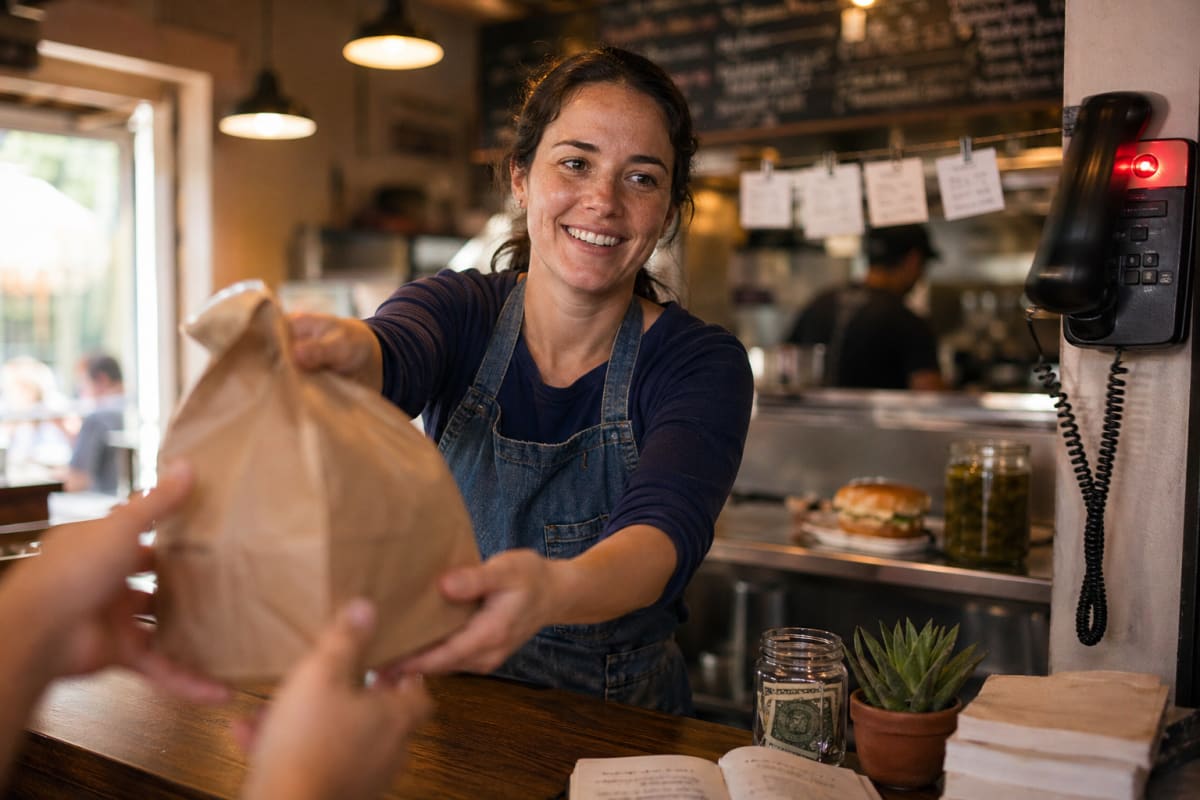
It's 12:14 PM. Your line is six deep at the counter. The kitchen is calling out tickets faster than you can mark them ready. The phone behind the register has been ringing for the last forty seconds.
You glance at it. The caller ID says it's a local area code. Could be a regular calling in a pickup order. Could be someone asking what time you close. Could be the office park down the street trying to set up catering for a Friday lunch meeting — twelve sandwiches, six salads, $340 ticket, repeatable weekly.
You don't know. And you have a customer in front of you waiting for their change.
You let the phone ring through. By the time the lunch rush quiets down at 1:35, the missed-call list is fourteen long. None of them left a voicemail. By 2:15 you've called three of them back, two went to voicemail, one was annoyed that "I called you forty minutes ago about catering for my office, never mind, we already ordered from somewhere else."
That somewhere else just got the catering order, the office's repeat business, and the chance to be the lunch caterer the office picks every Friday for the next two years.
This is the lunch rush phone problem in food service, and it's structurally different from every other "I can't answer the phone" problem. Plumbers can't take calls because they're under sinks. Electricians can't take calls because they're working live circuits. Landscapers can't take calls because their mowers are too loud to hear the phone. You can't take calls because there's a paying customer standing in front of you, holding a credit card, waiting for you to finish their order.
You can't leave the counter. The counter is the business.
What a missed restaurant call actually costs
The numbers in food service are different from the trades because the per-call values are smaller but the frequency is much higher and the customer types are stratified.
Single-customer takeout/pickup order. $15-$45 average ticket. The economics here aren't catastrophic per call, but at 20-30 missed calls per week during peak service, they add up.
Reservation for a 4-8 person party. $200-$800 in covers, depending on your average per-person spend. Friday and Saturday night reservations missed during dinner rush are the most expensive missed calls in casual dining. Industry data suggests restaurants miss anywhere from 25% to 43% of incoming calls during peak hours.
Large-party reservation (10-20 people). $500-$2,000+ in covers. A birthday dinner, a rehearsal dinner, a corporate team night. These are the calls that hurt the most when missed because they're irreplaceable for that specific evening.
Catering and private events. $300-$10,000+ per event, with the largest catering jobs (corporate retreats, weddings, full-service caterings) running well into five figures. The catering caller is the highest-value missed call in food service — and the one most likely to be calling during your busiest hours, because they're often planning during their own lunch break.
The math on a single mid-size restaurant in a typical week:
| Call type | Avg missed/week | Avg value | Weekly leak |
|---|---|---|---|
| Takeout/pickup orders | 20 | $25 | $500 |
| Small reservations | 8 | $250 | $2,000 |
| Large-party reservations | 1.5 | $700 | $1,050 |
| Catering inquiries | 1 | $850 | $850 |
| Weekly total | 30.5 | — | $4,400 |
That's ~$229,000 a year in capturable revenue going to voicemail, calculated conservatively. And the catering line alone is what really hurts: industry analyses show restaurants using 24/7 phone answering capture roughly 3x more catering and event inquiries than restaurants relying on staff-during-service-only.
Catering is the highest-margin food service revenue most restaurants can earn. The phone is the channel where catering happens. And the phone is the thing you can't reach during the hours catering buyers most often call.
The in-person customer paradox
Restaurants face a unique structural problem that no other industry has in quite the same form.
Every other small-business owner can, in theory, step away from their work to answer a phone — even if doing so badly is risky (electrician at a panel) or expensive (plumber mid-job). The work itself doesn't have a witness who will be insulted by the interruption.
Food service does. The customer at your counter watching you answer the phone is being abandoned in real time. Their burrito sits half-wrapped. Their drink is half-poured. They're watching you talk to someone on a phone instead of finishing their order.
This is the in-person customer paradox: the cost of answering the phone isn't paid in your time. It's paid in the other customer's experience. And the customer who waits 90 seconds while you take a phone call is the one who leaves the one-star review about how "the staff was distracted, kept answering the phone, took forever to ring me up."
So restaurants make a choice that all the missed-call advice ignores: they prioritize the in-person customer at the cost of the phone customer. They have to. The in-person customer is right there. The phone customer is hypothetical.
The result: missed catering inquiries, missed large-party bookings, missed pickup orders. The traditional "just answer the phone" advice doesn't work because it requires a tradeoff that's bad for the in-person experience. And in-person experience is what drives reviews, repeat visits, and word-of-mouth — the things that keep the in-person line full in the first place.
The fix has to be a structural one: a system that handles the phone without taking your eyes off the counter.
Why the standard fixes don't work for small restaurants
Most restaurant owners have tried at least two of the following:
Voicemail. The default. About 69% of unanswered restaurant callers never try again — they hang up and call the next restaurant. That number is higher than for the trades because food decisions are made fast. The takeout caller deciding between three places isn't going to leave a voicemail. They're going to scroll one more line down on Google.
Hire a dedicated phone person. Works for high-volume restaurants. For a small-to-mid restaurant, the math is brutal — a part-time phone person costs $1,800-$3,200/month. That eats most of the marginal revenue from the calls they'd capture. And during the non-rush hours (3-5 PM, after dinner), they're standing around with no calls to answer.
Online ordering only / "we don't take phone orders." Some restaurants have gone this route. It works for delivery-app-driven business. It does not work for catering, large parties, dietary accommodations, or any inquiry that needs back-and-forth. The phone-preferred caller is also disproportionately the high-value caller — corporate offices ordering catering, families planning rehearsal dinners, regulars who want to talk to a person.
Missed-call text-back. A bot sends an SMS when a call goes unanswered. Better than voicemail (it acknowledges the caller's existence), but it doesn't actually answer their question. The catering caller wanted to know if you can do twelve sandwiches by Friday at noon. A text saying "we missed your call, please reply with your question" doesn't get them to commit. Conversion lift over voicemail: real but modest.
Traditional answering service. Generic call-center agents reading scripts. Cost: $250-$700/month with per-minute fees. Problem: they don't know your menu, your catering minimums, your dietary capabilities, your hours during private events. Customers can tell when they're being handled by a generic operator, and the conversion rate on catering inquiries through these services is poor.
The fifth option — and the one most small restaurants have moved to in the last 18 months — is an AI receptionist trained on your specific menu, hours, catering capabilities, reservation rules, and FAQs. Picks up in under 5 seconds. Knows the difference between "can I get a 12-inch pizza for pickup in 20 minutes" and "we'd like to plan a catering for an office of 40 next Friday." Captures full catering details (date, headcount, dietary, budget, delivery vs pickup). Books reservations directly. Costs $29-$200/month flat rate.
For a restaurant losing $4,400/week to voicemail, the math typically pencils out to less than the cost of one missed catering order per month.
What a restaurant intake should actually do
Different food service calls need different handling. A trained system runs different scripts for the most common call types:
1. Takeout / pickup order. - Customer name and phone for pickup - What they want from the menu (with price quotes including tax) - Pickup time - Payment method (in person vs phone-on-file) - Allergies or dietary restrictions - Order goes directly to your kitchen ticket system
2. Reservation booking. - Date, time, party size - Any special occasions (birthday, anniversary) - Dietary restrictions or accommodations needed - Indoor/outdoor/bar preference if applicable - Booking lands directly in your reservation system
3. Catering inquiry. - Event date and time - Headcount - Delivery, pickup, or full-service drop-off - Dietary restrictions and accommodations - Budget range or per-person target - Type of event (corporate, family, etc.) - Captured as a high-priority lead with all details, alerts your catering manager
4. Private event / large party. - Event date, time, party size - Type of event - Any minimums or buyout requirements explained - Dietary needs - Captured for callback within an hour with private dining options
5. Hours, location, menu questions. - Answered immediately from the system's knowledge base - No staff intervention needed - Caller leaves with the information they wanted, not a frustrated impression
A trained system handles a takeout order in 90 seconds, a reservation in 60, a catering inquiry in 3-5 minutes — all while your staff is at the counter handling the in-person line.
The in-person experience doesn't degrade. The phone customer doesn't get lost. Both can be served well at the same time.
Test your current setup this week
The easiest test in food service is the one that mirrors a real catering buyer's behavior:
- Have a friend (not a regular customer) call your restaurant at 12:15 PM on a weekday. Have them ask: "Hi, I'm trying to set up catering for my office of 25 next Friday for lunch. Can someone help me with that?"
- Time how long until they reach a human or system. Stopwatch from dial to "yes, here's how we handle catering orders."
- Then have them call again at 6:45 PM Saturday during dinner service. Have them ask: "Hi, do you have a table available tonight for six around 8?"
- Compare the two outcomes. Did either get answered? Did the response include real qualifying questions? Did either result in a booked event or reservation?
The result is uncomfortable for most independent restaurant owners. Both calls happen at exactly the times you can't answer them. Both calls represent significant revenue that is routinely lost to whichever competitor can answer at those times.
Most restaurants run this test once and immediately know what to do.
What this is really about
Restaurant owners didn't get into the business to manage phones. They got into it to feed people, build a community, run a kitchen they can be proud of, and serve the customer in front of them well. The phone has always been an interruption — and during the hours when it actually matters most (lunch rush, dinner rush, weekends), it's an interruption that comes at the cost of the customer who's already standing at the counter.
The fix isn't to spend more time on the phone. It's to put a system in place that handles the phone while you handle the counter, captures the catering and reservation calls that drive your highest-value revenue, and hands you a clean queue of orders, reservations, and qualified catering leads at the end of every shift.
If you want to hear what a restaurant-trained intake sounds like, dial (513) 757-5127 or (947) 221-1601. Both are demo lines configured for trade businesses, but the same system can be configured for a restaurant in about ten minutes — with your menu loaded, your catering capabilities defined, your reservation rules, and your hours of operation. Tell it you want to set up catering for an office of 30. Listen for what it asks before it tries to capture the order.
The right answer to a 12:15 PM catering call is "let me get the details — what date is the event, how many people, and any dietary restrictions?" The wrong answer is the dial tone of voicemail. If your current setup gives the wrong answer, every lunch rush this month is a Friday catering account you'll never know about.
HiRiley is a 24/7 AI receptionist built for restaurants, contractors, and other local businesses, starting at $29/month with a free trial that doesn't require a credit card. Every call answered, every catering inquiry captured, even during the rush.
Try Riley
Stop missing calls.
10 free calls. No credit card. Live in under five minutes.
Keep reading
The First 90 Seconds of a Water Damage Call: What Restoration Companies Need to Capture Fast
Water damage callers are panicking as they dial — and the next 90 seconds decides whether…
Storm Damage Calls Don't Wait: How Roofers Capture Leak and Hail Leads Before the Next Contractor
Roofers miss 50-70% of calls during post-storm surges, when 48 hours decides 6 months of …

How Real Estate Agents Lose Buyer Leads in the First 90 Seconds (and How to Be the One Who Doesn't)
NAR data shows 78% of homebuyers work with the first agent who responds to their inquiry.…