Storm Damage Calls Don't Wait: How Roofers Capture Leak and Hail Leads Before the Next Contractor
Roofers miss 50-70% of calls during post-storm surges, when 48 hours decides 6 months of revenue. Here's the structural fix that beats the storm chasers to the call.
A hail storm rolls through your service area on a Tuesday afternoon. By 6 PM, homeowners are standing in their driveways looking at dented gutters, dimpled cars, and shingles in their flowerbeds. By 7 PM, they're on their phones, searching for roofing contractors. By 9 PM, the contractors who answered are already booked three weeks out.
By Wednesday morning — about 14 hours after the storm passed — you're playing voicemail tag with homeowners who have already signed with someone else. Some of them with out-of-state storm chasers who showed up in white pickup trucks the night before with no local reputation, no past customers, and no Google reviews. They just had one thing your firm didn't: somebody picking up the phone.
This is the storm surge cliff in roofing, and it's structurally unlike any other trade's missed-call problem. Plumbers and electricians have steady year-round demand with occasional emergency spikes. HVAC has predictable summer and winter peaks. Landscapers have a 90-day spring rush. Roofers have something different: a 48-to-72-hour window after every major storm where the market for the next 6 months gets decided. Miss the window, lose the season.
And the data on what most roofing companies do with that window is brutal: industry research consistently shows that post-storm missed-call rates run 50-70%, compared to a 27% baseline during normal operations. Roofing has the most volatile call volume of any home service trade, and the fewest companies structurally prepared to handle it.
What a missed roofing call actually costs
The economics are sharper in roofing than in most trades because the per-call values are unusually high.
| Job type | Typical value |
|---|---|
| Minor leak repair | $400-$1,500 |
| Section repair | $1,500-$5,000 |
| Asphalt shingle replacement (full roof) | $9,000-$15,000 |
| Metal roof replacement | $15,000-$30,000 |
| Tile roof replacement | $20,000-$45,000 |
| Storm damage / insurance claim job | $12,000-$25,000 average |
| Commercial flat roof | $20,000-$100,000+ |
The baseline number worth knowing: the average residential roofing job in 2026 runs around $9,500. The average storm-damage replacement runs $12,000-$25,000 and converts at notably higher rates than routine work because the homeowner is in active problem-solving mode, not browsing.
Industry analyses peg the average missed call cost for a roofing contractor at roughly $1,500-$2,500 in lost potential revenue once you factor in conversion rates. That's per missed call, conservatively. During a storm surge, with insurance-claim work in play, the per-call value runs much higher.
The math at a typical small roofing company on a normal week:
- 35-50 inbound calls per week
- 27% miss rate (normal baseline)
- ~10-13 missed calls per week
- ~$1,800 average value per missed call (blended across the job-type mix)
- Weekly leak: $18,000-$23,400
- Annual baseline leak: ~$900K-$1.2M
That's before a storm hits. The storm-week version of the math is dramatically worse.
The storm surge: 48 hours that decide the season
Most roofing markets in the central and southern U.S. have 2-4 storm events per year that meaningfully reshape the local market. Hail in spring. Wind events through summer. Hurricane bands and remnants in fall. Each event compresses what would normally be 4-6 weeks of demand into 48-72 hours.
Here's what that compression looks like operationally:
| Hour after storm | What's happening |
|---|---|
| 0-2 | Homeowners assess damage, check insurance |
| 2-12 | First wave of calls — typically the most informed homeowners |
| 12-24 | Peak call volume — typical day's volume in 6 hours |
| 24-48 | Second wave — homeowners who consulted neighbors, did online research |
| 48-72 | Inspection bookings consolidate; market essentially closed |
| 72-168 | Late callers, but most are already calling firms that confirmed appointments |
A roofing company doing 35 calls in a normal week may take 80-150 calls in the first 48 hours after a major storm. A typical office or solo dispatcher cannot answer that volume. Calls queue, hit busy signals, roll to voicemail. By Wednesday, the company hasn't responded to most of the storm leads. By Friday, the leads are gone.
The numbers from industry research are consistent: roofing companies miss 50-70% of calls during storm surges compared to 27% during normal operations. That's the difference between "we had a busy storm season" and "we lost the storm." Most owners can't tell the difference because the missed calls don't appear in any system they look at.
Why the standard fixes don't work for roofing
The four traditional answers don't quite work in roofing's storm-driven model:
Voicemail. The default. Industry research is unusually clear here: less than 3% of voicemail recipients leave a message during a roofing storm surge. Homeowners with shingles in the yard don't wait. They dial the next number. Voicemail is functionally a hangup with a beep.
Hire a part-time receptionist. $35,000-$55,000/year fully loaded. They cover 8 hours a day, Monday-Friday. They don't cover the Tuesday-evening surge after a 4 PM storm, the Saturday afternoon hail event, or the 9 PM call from a homeowner who watched a wind event blow through. They also can't physically handle 80 calls in the first 6 hours of a surge — that's a queue problem, not a staffing problem.
Traditional answering service. $300-$1,200/month with per-call or per-minute fees. Two structural issues. First, generic agents don't know roofing terminology — they can't tell a hot insurance lead from a homeowner price-shopping a future repair. Second, per-call billing scales the wrong way: your bill triples in the week you can least afford the unpredictability.
The "storm response" specialty firm. Some roofing-specific call services do exist. They typically work but cost $1,500-$5,000/month with multi-month commitments. Below ~$2M annual revenue, the math is hard to justify for off-season months when call volume is normal.
The fifth option — what a growing share of roofing companies have moved to in the last 18 months — is an AI receptionist trained on roofing intake and storm response. Picks up in under 5 seconds. Handles unlimited simultaneous calls (the queue problem disappears entirely — 40 callers all get answered at once). Knows the difference between "I have a slow leak" and "hail just hit, my whole roof is pitted, I need an inspection tomorrow." Books inspections directly into your calendar. Routes high-urgency insurance-claim calls for immediate callback. Costs $29-$200/month flat rate, regardless of whether you take 30 calls a month or 300.
The economics work because the cost is constant and the value is highest exactly when you'd otherwise be losing the most. Storm week generates 3-5x the savings of a normal week, but the bill is the same.
What good roofing intake actually does
Roofing storm calls aren't all the same. A trained intake script handles them differently based on what category they fall into:
1. Active leak (urgent residential repair). - Where is the leak — interior ceiling, around a vent, near a wall? - How long has it been leaking? Did it start recently or worsen? - Is the homeowner able to mitigate (buckets, tarps) safely? - Do they need same-day or can they wait until tomorrow morning?
2. Visible storm damage (highest-value category). - What kind of storm — hail, wind, fallen tree? - Approximate roof age and material type - Have they filed an insurance claim yet? If yes, which carrier? - Can they text photos of visible damage? - When can they have an inspector out?
3. Insurance claim job (warmer than warm). - Has the adjuster already inspected, or are you helping document first? - What did the carrier estimate? (If they have it.) - Has the homeowner picked a contractor yet, or are they still vetting? - Routed to senior estimator for same-day callback at the latest.
4. Pre-storm precautionary inspection. - Visible concerns the homeowner has noticed - Roof age and last inspection - Lower urgency — schedule for normal availability
5. Routine quote (replacement project, no current damage). - Roof age, material preferences, project timeline - Budget tolerance (or financing interest) - Standard scheduling — not a surge call
A trained system runs through these in 90-120 seconds per call, captures the right info for each category, and routes the high-priority calls (categories 2 and 3) for immediate callback while booking categories 1, 4, and 5 directly into the calendar.
For storm surges specifically, the system also flags repeat callers from the same neighborhood — useful intelligence when 17 callers from the same ZIP code suggest a hail core that the company should respond to as a market.
The crew-safety angle
There's one more reason roofers can't answer calls during peak periods that most non-roofing observers miss: the work is physically dangerous to interrupt.
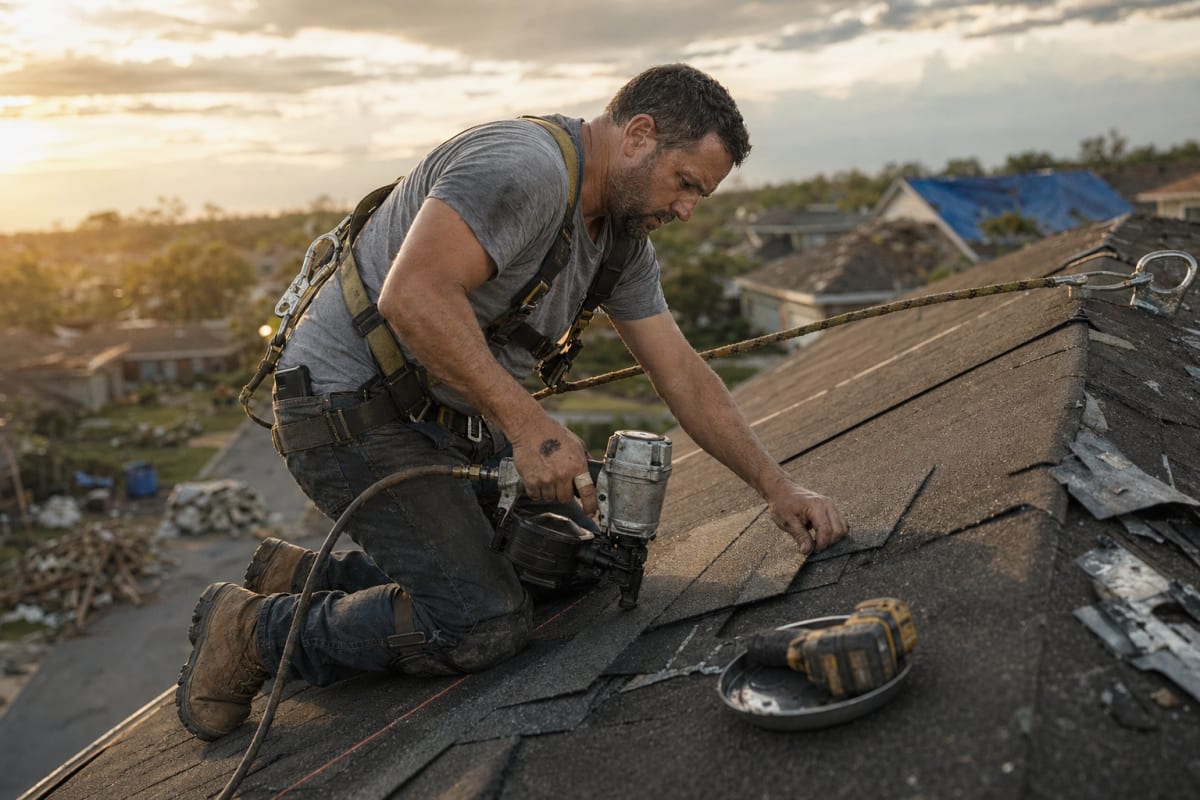
A roofer on a steep slope, harnessed in, with nail guns and shingles staged on the deck, cannot pull out their phone without taking off gloves, finding a stable position, and stepping away from the work. That's a 60-90 second interruption that creates safety risk and breaks the production rhythm. It's also why most crew leads put their phones on silent during installation — and why "the boss is up on a roof" is a real, daily reason calls get missed.
Roofing has the same fundamental "physically can't answer" problem that electricians and landscapers have, with the added factor that the roof is literally the most dangerous workplace in residential construction. OSHA fall-protection rules exist for a reason. The phone losing the lead is a small price to pay compared to the alternative.
The fix isn't asking crews to answer faster. It's making sure the phone gets answered by something else while the crew works safely.
Test your current setup before the next storm
The cleanest test for a roofing company is to mirror an actual storm-affected homeowner's behavior:
- Have a friend (not a current customer) call your business line at 7:30 PM on a weekday, simulating an evening storm response. Have them say: "Hi, we just had a bad hail storm and I can see damage on my roof. Can someone come out for an inspection?"
- Time how long until they reach a human or system. Stopwatch from dial to "yes, we can have someone out tomorrow morning at 9 AM."
- Have them call again at 11 AM Saturday. "Hi, my roof has been leaking since the rain last night. What does it cost for someone to come look at it?"
- Compare the two outcomes. Did either get answered live? Did either result in a booked inspection?
Most roofing owners run this test once and discover that both inquiries hit voicemail. The result is uncomfortable in normal operations and catastrophic during a storm surge. It's also actionable — once you've measured the gap, the math on what to do becomes obvious.
What this is really about
Roofing is a feast-or-famine business that runs on a few critical 48-hour windows each year. The contractors who win those windows fill their schedules for the season. The contractors who don't watch their best months walk to whoever's phone got picked up.
The fix isn't bigger ad spend during storm season — though most contractors instinctively try that first. The fix is making sure the phone gets answered when the storm hits, the queue doesn't choke, and the inspection gets booked before the homeowner dials the next contractor.
If you want to hear what a storm-response intake sounds like, dial (513) 757-5127 or (947) 221-1601. Both are demo lines configured for trade businesses, but the same system can be configured for a roofing company in about ten minutes — with insurance carrier handling, hot-lead routing, photo intake via SMS, and storm-surge auto-scaling built in. Tell it you have hail damage and need an inspection. Listen for what it asks before it tries to book the appointment.
The right answer to a 7:30 PM storm-response call is "I can have an inspector at your house tomorrow morning at 9 — what's your address?" The wrong answer is the dial tone of voicemail. If your current setup gives the wrong answer, every storm this season is a market your competitors are about to take from you in the next 48 hours.
HiRiley is a 24/7 AI receptionist built for roofing companies, contractors, and other home service businesses, starting at $29/month with a free trial that doesn't require a credit card. Built so the storm surge doesn't take your season.
Try Riley
Stop missing calls.
10 free calls. No credit card. Live in under five minutes.
Keep reading
The First 90 Seconds of a Water Damage Call: What Restoration Companies Need to Capture Fast
Water damage callers are panicking as they dial — and the next 90 seconds decides whether…

How Real Estate Agents Lose Buyer Leads in the First 90 Seconds (and How to Be the One Who Doesn't)
NAR data shows 78% of homebuyers work with the first agent who responds to their inquiry.…

Run a 15-Minute Missed-Call Audit: Find the Revenue Leaks Hiding in Your Phone Log
62% of small business calls go unanswered, costing $50K-$500K a year in invisible revenue…