
The First 90 Seconds of a Water Damage Call: What Restoration Companies Need to Capture Fast
Water damage callers are panicking as they dial — and the next 90 seconds decides whether the job is yours or your competitor's. Here's the structural fix.
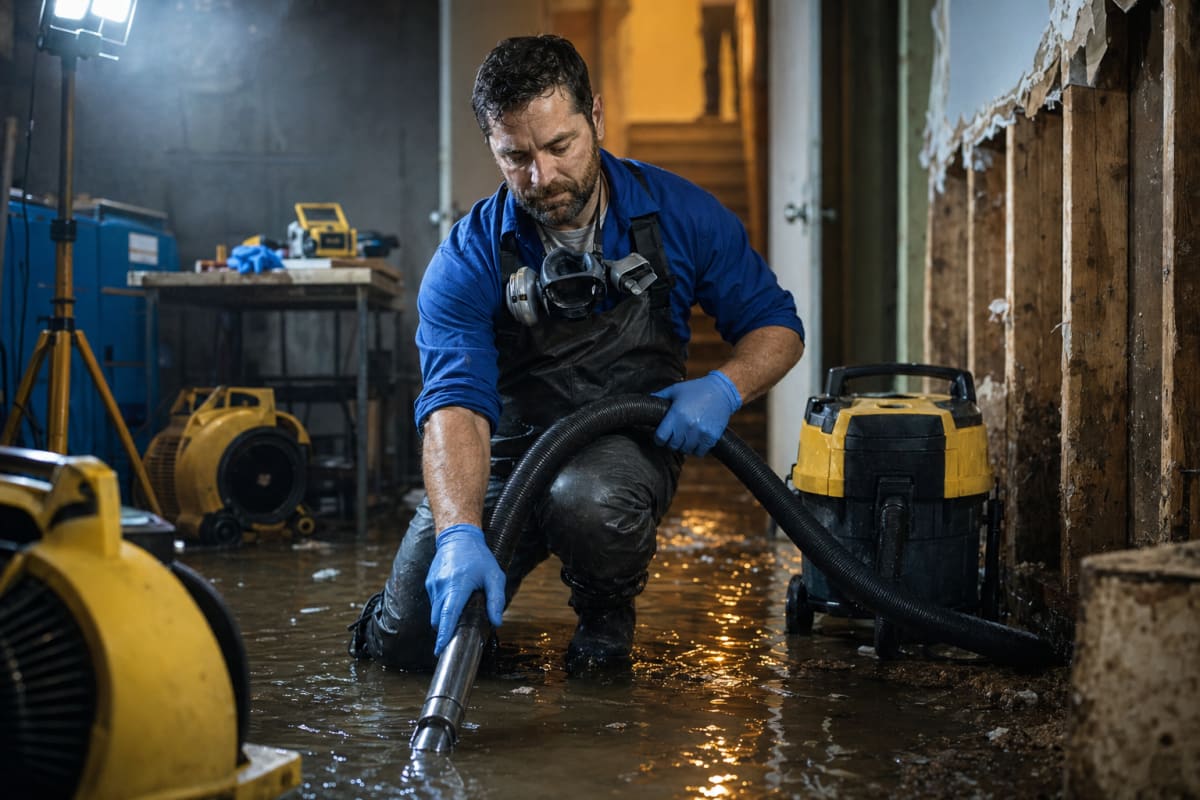
The phone rings at 11:23 PM. The voice on the other end is shaking.
"My basement is flooding. There's water everywhere. I don't know what to do. The pipe — I think it's the water heater, water is just pouring out, I — please, can you come?"
The next 90 seconds of that call decide three things: whether the homeowner trusts your company enough to commit before they call the next number on Google, whether their flooring survives the night, and whether the eventual job becomes a $4,000 mitigation or a $35,000 mold remediation and reconstruction.
Water damage restoration is structurally unlike any other trade in one specific way: the caller is actively in crisis as they dial. A plumber gets calls from homeowners with slow leaks who've been ignoring the problem for a week. A roofer gets calls from homeowners reviewing storm damage from a neighbor's driveway. A water damage caller is standing in the damage. The water is rising. The clock is the enemy. Every minute of voicemail purgatory is real measurable property damage.
This is why restoration companies that miss calls don't just lose revenue — they lose to themselves. The same homeowner who would have written your firm a $15,000 check tomorrow morning is writing it to the next number on the list tonight. And by 11:30 PM, when you check your missed-call notification, the job and the relationship and the insurance carrier preference and the eventual reconstruction work have all already gone elsewhere.
The economics of restoration and why missing one call hurts
Restoration job values are unusually high because the work bundles three distinct phases — mitigation, drying, reconstruction — that compound into significant tickets:
| Job type | Typical value |
|---|---|
| Minor water mitigation (small leak, single room) | $2,500-$5,000 |
| Standard water damage (multi-room, drying) | $5,000-$15,000 |
| Major flooding event (basement, multi-floor) | $15,000-$45,000 |
| Sewage backup (Cat 3 water) | $10,000-$30,000 |
| Mold remediation (post-water-event) | $5,000-$25,000 |
| Full reconstruction after water | $25,000-$150,000+ |
| Fire + water (firefighting damage) | $30,000-$200,000+ |
The industry phrase you'll hear from veterans: "there's no such thing as a $200 restoration job." The minimum-size mitigation project starts at multiple thousands, and the bundle of mitigation + drying + reconstruction often crosses five figures before any final invoice is written.
Layer in insurance. Most water damage jobs run through the homeowner's insurance carrier. That makes the contractor selection moment unusually important: once the homeowner picks a restoration company and the carrier's adjuster begins working with that contractor, switching is administratively painful. The phone call where the homeowner picks who's coming over isn't just a service scheduling decision — it locks in the relationship for the entire claim, including the reconstruction phase that may not happen for weeks.
A typical small restoration company doing $1.5M-$3M annual revenue handles 8-15 emergency calls per week, with significant after-hours weighting. If even 3 of those calls per week go to voicemail (a conservative number given the after-hours pattern), at an average $8,000 job value and a 50% close rate from answered calls vs 10% from missed-call callbacks, the math is:
- 3 missed calls × 52 weeks = 156 missed calls per year
- Convertible gap (40 percentage points): 62 jobs per year not booked
- Average value: $8,000
- Annual revenue leak: ~$498,000
That's before counting the lost reconstruction work, the lost insurance carrier relationships, and the lost referral economics. Restoration is the single most expensive vertical in the cluster to miss calls in.
The 24-hour cliff
Most service trades have time-sensitive calls but no physical timeline that punishes delay. Water damage has one of the sharpest physical timelines in any trade:
- 0-1 hour: Active water flow. Mitigation goal: stop the source.
- 1-4 hours: Standing water spreads. Flooring, baseboards, drywall begin saturating.
- 4-12 hours: Materials swell and warp. Hardwood lifts. Drywall sags. Insulation soaks.
- 12-24 hours: Structural materials weaken. Subfloor saturation begins.
- 24-48 hours: Mold spores activate and begin colonizing. The job category shifts.
- 48+ hours: Mold remediation now required on top of water mitigation. Costs roughly double.
The 24-hour cliff is the line where a $5,000 water mitigation becomes a $15,000-$25,000 mold remediation. The 4-6 hour cliff is the line where saveable flooring becomes replaceable flooring. Every voicemail-to-callback delay pushes the homeowner closer to those cliffs — and turns a manageable job into a major loss.
This is why the homeowner with the active leak sounds panicked on the phone. They've usually figured out (correctly) that the longer they wait, the worse the math gets. They're trying to get a contractor on-site in the next 60-90 minutes, not the next day. The contractor who answers gets the job. The contractor who doesn't is functionally not in the running.
What a panicked water damage caller actually needs in 90 seconds
The intake script for water damage isn't like any other vertical's. The caller is in active distress, the property is actively being damaged, and the call has to do three jobs at once:
Job 1: Calm the caller. A panicked homeowner can't give you good information. The first words on the line set the tone for everything else. "Take a breath. We do this every day. Tell me what's happening." That single sentence often visibly shifts the caller from panic to problem-solving mode.
Job 2: Triage the situation and give immediate mitigation instructions. This is unique to water damage among service trades. Most intake scripts just gather information. Restoration intake also has to help the homeowner reduce damage right now, before anyone arrives:
- "Can you safely get to the main water shutoff? It's usually near the water heater or where the main enters the house."
- "If you can't shut off the source, can you turn off the breaker for the affected area to be safe with electrical?"
- "Don't use any wet vacuums or extension cords near the water — wait for our team."
- "Move what you can lift to higher ground — move pictures, electronics, anything light."
- "Don't try to dry it yourself with fans tonight — we have commercial drying equipment we'll bring."
The mitigation instructions are the trust earner. You've now helped them before charging them. The homeowner who got those five sentences from your firm isn't calling the next number on Google. They're waiting for your truck.
Job 3: Capture the dispatch information and confirm an arrival window. Address. Type of water (clean / gray / sewage). Approximate area affected. Insurance carrier (if known). Best callback number. Confirmed arrival time.
A trained intake script runs through all three jobs in 90-120 seconds total, dispatches the technician to the address, and texts the homeowner a confirmation with the technician's name and ETA — all while the homeowner is still standing in the basement with their pant legs rolled up.
Why standard fixes don't work for restoration
The four traditional answers don't quite work in restoration's crisis-call model:
Voicemail. The default. Industry data is unusually clear here: the panicked-caller version of the voicemail abandonment rate is even higher than the trades' baseline of 80%. People in active crisis don't leave messages. They dial the next number. Voicemail is functionally an off-switch on the emergency pipeline.
Hire a part-time receptionist. Restoration's emergency calls don't follow business hours. A 9-to-5 receptionist covers the 30% of calls that come in during their shift. The 70% that come in evenings, weekends, holidays, and middle-of-the-night — exactly when most water damage emergencies happen — still go to voicemail.
Traditional 24/7 answering service. The closest match to restoration's needs, and what most mid-size companies use. The problems: $400-$1,200/month plus per-call fees, generic agents who haven't been trained on water damage triage, no ability to give meaningful mitigation instructions, and noticeable lag time when callers are routed through a queue ("please hold for the next available agent" is the wrong message for someone watching water rise).
On-call rotation among technicians. Common at small restoration companies. Works structurally but burns out the team — being on-call every third night for years is the kind of grinding fatigue that drives industry turnover. Also creates inconsistent triage: the technician who's tired at 2 AM is going to take a worse call than the one who's fresh at 9 AM.
The fifth option — and the one a growing number of restoration companies have moved to in the last 18 months — is an AI receptionist trained on water damage intake specifically. Picks up in under 5 seconds. Knows the difference between "my basement is flooding" and "I noticed a small leak under the sink." Runs the calm-caller-then-mitigate-then-dispatch script the same way every time. Routes Cat 3 (sewage) calls and large-volume flooding emergencies for immediate technician callback. Books smaller mitigation jobs directly into the morning schedule. Costs $29-$200/month flat rate regardless of call volume.
For a company losing ~$500K/year to voicemail in this category, the math typically pencils out to less than the cost of one captured mitigation job per quarter.
The categories of water damage call
A trained restoration intake handles different call categories with different urgency:
Tier 1 — Active emergency (dispatch within 60 minutes): - Active flooding from any source (burst pipe, water heater rupture, supply line failure, appliance overflow) - Sewage backup affecting living areas - Storm/flood event causing water intrusion - Fire + water (post-firefighting cleanup) - Slab leaks with active water visible
Tier 2 — Same-day urgency (dispatch within 4-8 hours): - Slow leak that's been escalating - Roof leak after weather event (water now contained but materials wet) - Toilet overflow with cleanup needed but source stopped - Discovered moisture damage requiring immediate assessment
Tier 3 — Next-day to scheduled: - Visible mold concerns (no active water source) - Post-event reconstruction estimates - Insurance claim follow-up calls - Pre-purchase inspections, moisture mapping for real estate
Tier 4 — Information / non-emergency: - Quote requests for known projects - Insurance estimate documentation - Existing customer follow-up
The structural value of category-based intake is that Tier 1 calls don't get queued behind Tier 4 calls. The homeowner with active flooding doesn't sit on hold while another caller asks about scheduling next month's mold inspection. AI handles the queue problem trivially because it answers all calls in parallel.
Why the insurance angle makes the missed-call cost even bigger
Most restoration jobs run through the homeowner's insurance carrier. That introduces a wrinkle that doesn't exist in most trades:
The homeowner's contractor selection happens fast, then locks in. Once the homeowner picks who's coming over for the emergency mitigation, that contractor typically:
- Documents the damage for the insurance claim
- Communicates directly with the adjuster
- Becomes the carrier's reference point for the file
- Gets right of first refusal on the reconstruction work
Switching contractors mid-claim is administratively painful for the homeowner, the carrier, and the adjuster. So the phone call where the homeowner picks isn't just choosing tonight's mitigation — it's choosing the company that gets the entire bundle: emergency response, drying, demolition, reconstruction. That bundle often runs $25,000-$75,000+ for a meaningful event.
A missed call at 11 PM isn't a $4,000 lost mitigation. It's a $35,000 lost claim relationship plus the future referral business from that homeowner's neighbors who experienced the same storm. The compounding makes restoration's missed-call economics uniquely sharp.
Test your current setup before the next storm
The cleanest test for a restoration company is to mirror an actual panicked homeowner:
- Have a friend (not a current customer) call your business line at 10:45 PM on a weeknight. Have them say: "Hi, my water heater just burst, my basement is filling up, I don't know what to do."
- Time how long until they reach a human or system. Stopwatch from dial to "we have a tech on the way, and here's what to do until they arrive."
- Listen for whether the response includes mitigation instructions — the universal first question should be about whether the water is shut off, and the response should give clear safety guidance before booking the dispatch.
- Have them call again at 6 AM Sunday with a different scenario: "Hi, I just noticed my carpet is wet near the wall and there's a musty smell. Can someone come look?"
- Compare the two outcomes. Did either get answered? Did the response correctly distinguish the urgency levels?
Most restoration owners run this test once and discover that both calls hit voicemail or, worse, hit a generic answering service that fails to ask the right questions. The result is uncomfortable in normal operations and catastrophic during a storm event when call volume triples.
What this is really about
Water damage restoration is a business built on trust earned in the worst moments of someone's life. The homeowner standing in 3 inches of basement water at 11 PM remembers two things ten years later: who picked up the phone and how that person made them feel. Everything that happens after — the drying, the demolition, the reconstruction, the insurance paperwork — flows from that single phone call.
The fix isn't to be on call yourself for the next 30 years. It's to put a system in place that picks up every emergency call within 5 seconds, runs the calm-caller-then-mitigate-then-dispatch script consistently, captures the right information for insurance, and books the technician dispatch while you're asleep, on another job, or at your kid's baseball game.
If you want to hear what a restoration-trained intake sounds like, dial (513) 757-5127 or (947) 221-1601. Both are demo lines configured for trade businesses, but the same system can be configured for a water damage restoration company in about ten minutes — with the calm-caller protocol, the mitigation instructions specific to your service area, the Cat 1/2/3 water classification logic, and direct technician dispatch built in. Tell it your basement is flooding. Listen for what it asks first, and what it tells you to do before the truck arrives.
The right answer to an 11 PM water-emergency call is "take a breath, we do this every day, can you safely get to the main water shutoff?" The wrong answer is the dial tone of voicemail. If your current setup gives the wrong answer, every storm season is six figures of revenue going to whoever picked up first.
HiRiley is a 24/7 AI receptionist built for water damage restoration companies, contractors, and other emergency-response businesses, starting at $29/month with a free trial that doesn't require a credit card. Built for the calls that can't wait.
Try Riley
Stop missing calls.
10 free calls. No credit card. Live in under five minutes.
Keep reading
Storm Damage Calls Don't Wait: How Roofers Capture Leak and Hail Leads Before the Next Contractor
Roofers miss 50-70% of calls during post-storm surges, when 48 hours decides 6 months of …

How Real Estate Agents Lose Buyer Leads in the First 90 Seconds (and How to Be the One Who Doesn't)
NAR data shows 78% of homebuyers work with the first agent who responds to their inquiry.…

Run a 15-Minute Missed-Call Audit: Find the Revenue Leaks Hiding in Your Phone Log
62% of small business calls go unanswered, costing $50K-$500K a year in invisible revenue…