
No-Cool Calls Don't Wait: How Small HVAC Shops Capture Summer Emergencies Without Hiring a Dispatcher
HVAC call volume can spike 340% on the first 90-degree day. Here's why missed summer calls cost more than you think — and how small shops handle the surge without a dispatcher.
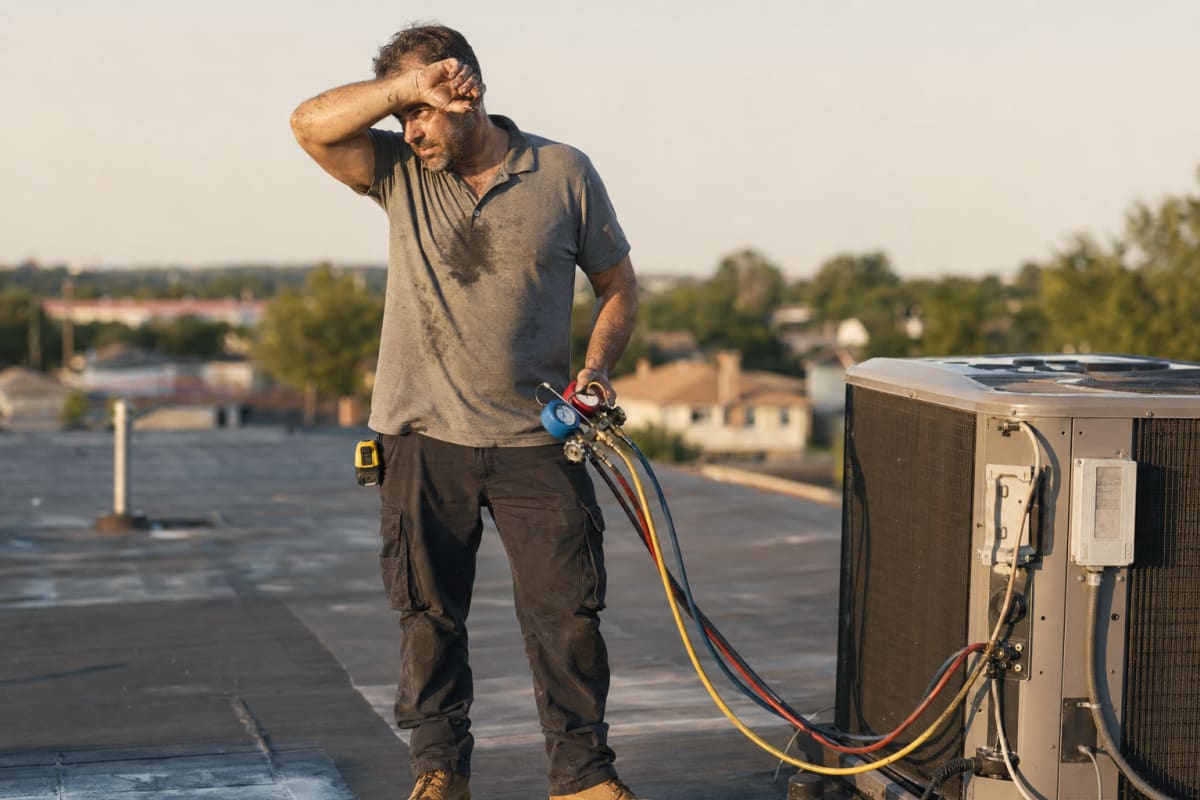
It's the first 95-degree day of the year. By 4 PM, every AC unit in your service area that was barely hanging on through spring has finally given up.
Phones are ringing across your market. Homeowners standing in 88-degree living rooms, kids cranky, dogs panting, dialing whoever shows up first on Google. They're not browsing. They're not comparing reviews. They're calling the first three numbers and going with whoever answers.
You've got two techs out in the field, both elbow-deep in attic crawls. Your phone is buzzing in the truck cup holder, but you can't hear it over the compressor. By the time you check your missed calls at 6 PM, eleven of them have already booked with someone else.
This is the economics of summer in HVAC, and it's the most expensive structural problem in the industry — bigger than parts pricing, bigger than tech pay, bigger than equipment costs. The shops that solve the phone problem capture the season. The shops that don't watch their best month walk straight to the competitor who hired a dispatcher.
The good news: you don't need to hire one.
The summer surge is brutal — and predictable
Industry data on HVAC call patterns is some of the cleanest in any trade:
- HVAC call volume can increase by up to 340% during peak summer compared to mild spring periods.
- The single highest-volume day of the year for emergency HVAC calls is typically the first day a region exceeds 90°F, with call volume jumping 300% above average.
- Roughly 62% of HVAC customer calls happen outside traditional 9-to-5 business hours — concentrated in evenings, weekends, and holidays.
- Around 73% of an HVAC contractor's annual revenue is concentrated in just six months: June through August and December through February.
Translated: most of your year's money comes from half the year's calendar, the calls cluster after hours, and the volume can triple in 48 hours when the weather turns. That's not a staffing problem you can solve by working longer days. It's a structural problem that requires a structural fix.
What a missed no-cool call actually costs
Plumbers tend to think of missed calls in $300-$500 increments. HVAC is in a different financial bracket entirely.
A typical no-cool emergency call breaks down something like this:
| Revenue layer | Typical value |
|---|---|
| Emergency dispatch fee | $100-$250 |
| Diagnostic and labor | $200-$400 |
| Parts and repair (capacitor, contactor, refrigerant) | $150-$800 |
| Single-call total | $450-$1,450 |
That's just the immediate ticket. The real number is much larger because no-cool calls are gateway events. The customer who watched you save their summer becomes:
- A maintenance plan signup ($150-$300/year, often for years)
- A spring tune-up customer ($80-$150/year)
- The eventual system replacement when their unit ages out ($6,000-$15,000)
- A referral source for neighbors and family members
Industry analyses peg the five-year lifetime value of an HVAC customer at $2,000-$5,000 in a typical residential market. So when a competitor picks up the call you missed, they're not just taking a $600 service ticket. They're taking five years of that household's HVAC spend, plus whatever the homeowner refers their way after a stressful day where someone showed up.
You got a missed-call notification. They got a customer.
Why the standard fixes don't work for small shops
When the call volume problem becomes obvious, most shop owners reach for one of three solutions. None of them solve it cleanly:
Solution 1 — "We'll just answer faster."
This is the response 65% of HVAC companies actually choose: existing techs work longer hours, the owner answers calls in the truck, the spouse picks up at home. It works for about three weeks. Then somebody burns out, somebody misses a 7 PM call because they're at their kid's baseball game, and the cycle repeats. You can't will your way out of a 340% volume surge with the same number of people.
Solution 2 — Hire a dispatcher.
A dedicated phone person costs $40,000-$60,000/year fully loaded (salary, benefits, taxes, equipment, training). For a small shop running two or three trucks, that's a real chunk of your bottom line — and it only solves coverage during the hours that person works. After-hours emergency calls, which are the highest-value calls in your business, still go to voicemail.
A dispatcher makes sense once you're booking 10+ jobs a day and need full-time office support. Below that scale, the math doesn't work.
Solution 3 — Traditional answering service.
A live human call center picks up on your behalf. Cost typically runs $300-$700/month with per-call or per-minute fees that scale with volume — meaning your bill goes up exactly when summer hits and you can least afford the unpredictability. The agents are usually trained generically, not on HVAC, so they're taking messages and hoping the homeowner waits for your callback.
A homeowner whose AC failed at 4 PM on a 95-degree day doesn't wait for callbacks.
What actually works for small shops
The fix that's emerged in the last two years is fundamentally different from any of the above: an AI receptionist that answers every call in under two seconds, sounds like a human, asks the right HVAC-specific questions, identifies emergencies, transfers them to your phone in real time, and books routine calls directly into your calendar.
Three things make this work where the old solutions fail:
1. It scales without scaling your costs.
A traditional answering service charges per call. When summer hits and your call volume triples, your bill triples too. An AI receptionist runs flat-rate — $29-$200/month depending on volume — whether you take 50 calls or 500 in a given month. The economics actually improve during your busiest weeks instead of getting worse.
2. It runs the same script every time.
Most missed calls aren't missed because nobody picks up. They're missed because the wrong person picks up — a tech in a hurry, a spouse covering during dinner, a friend filling in. Each of them handles the call differently, captures different details, and converts at different rates. A modern AI agent runs the same intake script on every call: greet, identify problem, capture address, classify urgency, transfer if emergency, book if routine. Consistency at 100 calls per day that no human can match.
3. After-hours coverage costs the same as daytime.
The most expensive single problem in HVAC is that 62% of your calls happen when your office is closed. Hiring people to cover those hours is brutally expensive — overnight staffing destroys margins. AI doesn't sleep, doesn't get paid more for night shifts, and doesn't take Christmas off. The 11 PM no-heat call gets the same level of professional handling as a 10 AM tune-up scheduling call.
The "first to answer wins 78%" math, applied to summer
Across multiple lead-response studies, one number keeps showing up: roughly 78% of customers buy from the first business that responds to their inquiry. For HVAC emergencies, that number is almost certainly higher — homeowners with no AC on a 95-degree day aren't comparison shopping.
Translated to the summer surge: every emergency call you answer in the first two seconds is one your competitor doesn't get. Every call that hits voicemail is one they do.
If your shop typically misses 10-15 calls per week during peak summer (a conservative estimate for a two-truck operation), and the average no-cool call is $600 immediate revenue plus $2,500 in lifetime value, that's somewhere between $30,000 and $45,000 in capturable revenue per summer week slipping by. Over twelve weeks of peak season, the math gets uncomfortable fast.
A solution that captures even half of those calls is the difference between a year you grow and a year you tread water.
How to test this without committing
If you've never run the numbers on your own shop's missed-call rate, three things will tell you most of what you need to know:
- Pull your phone log for the last seven days. Count the calls you didn't answer. Don't estimate — count.
- Multiply by your average per-call value. Even a $300 ticket times 10 missed calls per week is $12,000 a month in lost revenue.
- Compare that number to the cost of a $29-$200/month system that answers every call.
Most HVAC shop owners run that math once and immediately know what to do. The bigger question isn't whether to fix it — it's how fast.
If you want to hear what an AI receptionist sounds like answering a real HVAC call, dial (513) 757-5127. That's our demo line, answering as a fictional HVAC company. Tell it your AC isn't blowing cold. Listen to how fast it picks up, what it asks, and how it captures the details. Then check the time it took compared to the last time you got back to a customer's voicemail.
The shops that win the summer aren't the ones with the most technicians. They're the ones whose phone never goes unanswered.
HiRiley is a 24/7 AI receptionist built for HVAC, plumbing, and other local service businesses, starting at $29/month with a free trial that doesn't require a credit card. Built for the season your phone can't sleep through.
Try Riley
Stop missing calls.
10 free calls. No credit card. Live in under five minutes.
Keep reading
The First 90 Seconds of a Water Damage Call: What Restoration Companies Need to Capture Fast
Water damage callers are panicking as they dial — and the next 90 seconds decides whether…
Storm Damage Calls Don't Wait: How Roofers Capture Leak and Hail Leads Before the Next Contractor
Roofers miss 50-70% of calls during post-storm surges, when 48 hours decides 6 months of …

How Real Estate Agents Lose Buyer Leads in the First 90 Seconds (and How to Be the One Who Doesn't)
NAR data shows 78% of homebuyers work with the first agent who responds to their inquiry.…