
When the Lights Go Out, Voicemail Loses: A Missed-Call Guide for Solo Electricians
Electricians miss 40-60% of calls — the highest rate in the trades — because reaching for a phone while doing live work is dangerous. Here's the structural fix.
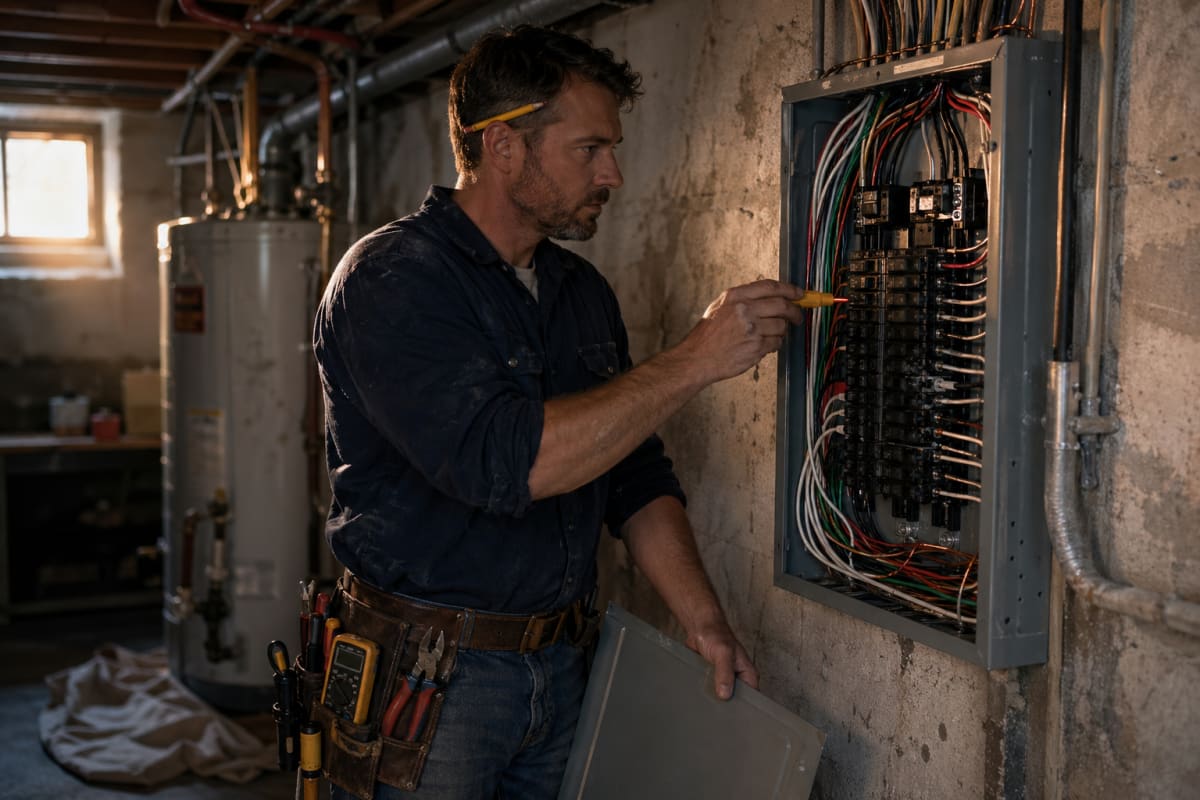
You're standing on a ladder with one hand on a junction box and the other holding wire strippers. Your phone is in your back pocket. It's been buzzing for forty seconds.
You don't reach for it. Reaching for it would mean letting go of either the live work in front of you or your balance. Both of those decisions can kill you.
By the time you climb down, the call has gone to voicemail. You check the screen — unknown number, no message. You hit callback. It rings four times. Goes to voicemail. You'll never know what that customer needed, whether it was a $200 outlet swap or a $4,000 panel upgrade, or whether they were calling about something dangerous that just got worse while their phone search continued down the list.
This is the structural problem of being an electrician in 2026, and it's worse than it is for any other trade. Industry data consistently shows electricians miss between 40% and 60% of incoming calls during work hours — the highest miss rate in the trades — because the nature of the work makes answering the phone genuinely dangerous, not just inconvenient.
You can't safety-share your way out of it. You can't will yourself to be faster. The fix has to be structural.
What a missed electrician call actually costs
The economics of missed electrician calls are similar to plumbing in shape but worse in two ways: the after-hours skew is sharper, and the emergency-call premiums are higher.
Average electrical service call value: $300-$400 in immediate revenue, according to HomeAdvisor and IBISWorld pricing data.
Average emergency call value: $500-$800 in immediate revenue, plus diagnostic and labor on top.
Average panel upgrade or major project value: $2,000-$5,000.
Average commercial project or rewire: $5,000-$25,000.
Now layer in the after-hours problem: NECA data indicates roughly 58% of calls to electrical contractors happen outside standard 9-to-5 hours — concentrated in evenings, weekends, and after storms. These are calls from homeowners who got home, flipped a switch, and discovered something wrong. Or who waited until the workday ended before dealing with the flickering light they've been ignoring. Or whose breaker just tripped during dinner and won't reset.
When those calls hit voicemail, roughly 80% of the callers don't leave a message — they simply hang up and dial the next electrician. Studies of speed-to-lead consistently show that 78% of customers hire the first business that responds, and for emergency electrical situations involving safety hazards (sparks, burning smells, smoke, no power) that number is almost certainly higher.
A simple version of the math, for a solo electrician who's honest about miss rate:
| Metric | Conservative | Typical |
|---|---|---|
| Calls per week | 25 | 40 |
| Miss rate (during work + after hours) | 40% | 50% |
| Missed calls per week | 10 | 20 |
| Conversion if answered | 35% | 35% |
| Average job value (blended) | $400 | $400 |
| Annual revenue leak | $72,800 | $145,600 |
Even the conservative version is enough to fund a full-time apprentice and a second truck. The typical version is enough to double the size of a small shop. And neither of these numbers accounts for the panel upgrades, rewires, and commercial projects that get lost in the same voicemail purgatory as the $400 outlet calls.
Why electricians can't just "answer faster"
Every other trade has a "just answer the phone more" workaround, even if it's exhausting. Electricians don't, because the actual physics of the work make it dangerous.
A plumber under a sink has wet hands. Inconvenient. Reachable phone if they really need to.
A carpenter on a roof has tools out and gravity working against them. Inconvenient. Phone in pocket, reachable.
An electrician in a live panel has 240 volts inches from their hand and is concentrating on not arc-flashing themselves. Reaching for a phone in this situation is the kind of thing that ends a career or a life. The same applies to anyone pulling wire through a wall, working in a tight ceiling cavity, or troubleshooting a hot circuit on a service call.
This is why electricians have the highest miss rate of any trade. It's not laziness. It's not poor business habits. It's the actual safety constraints of the work. The phone is in the pocket because that's where it has to be.
The result: you cannot solve this problem by trying harder. You have to solve it with a system that picks up the phone while you keep both hands on the work.
The four kinds of calls electricians miss
Not every missed call is the same. Understanding the mix helps clarify what kind of system actually solves the problem.
1. Active safety emergencies. Sparking outlets, burning smells, electrical fires, smoke from a panel, complete loss of power in extreme weather. These calls require immediate response — not just "answer the phone" but "get an electrician there in under two hours." A homeowner whose panel is sparking is calling 911-style: every electrician in the search results until someone picks up.
2. Functional urgencies. Tripped breakers that won't reset, no power to half the house, GFCI outlets that keep popping, a single circuit dead. These aren't immediate safety hazards but they're disrupting normal life. The customer wants you today, not Tuesday. Premium pricing applies.
3. Project quotes. Panel upgrades, EV charger installations, whole-home rewires, recessed lighting, ceiling fan installs, dedicated circuits. These are bigger jobs ($1,500-$15,000+) but the customer is shopping. They'll call 2-4 electricians and book whoever responds first with reasonable pricing.
4. Routine and price shopping. Outlet swaps, single fixture replacements, minor diagnostics. Lower ticket but real revenue. The customer often calls 1-2 electricians and books quickly if anyone answers.
The first two categories — about half of all incoming calls for most residential electricians — are genuinely time-sensitive. The other half are revenue you'll lose if you don't pick up reasonably fast.
What "good" looks like for electrician phone handling
The bar for good phone handling isn't complicated, but every solution has to clear it:
- Picks up in under 5 seconds. Voicemail loses the speed race before it starts.
- Recognizes danger words. Sparking, burning, smoke, fire, no power, panel — these have to trigger different handling than "I'd like a quote on recessed lights."
- Captures the right info on every call. Address, problem, urgency, callback number, preferred time. Same info, every call, no matter who's working the phone.
- Transfers real emergencies in real time. Not "we'll have him call you back." Live transfer, while the customer is still on the phone.
- Costs less than one missed emergency call per month. Otherwise the math doesn't work.
The traditional answers — voicemail, missed-call text-back, human answering service, dedicated dispatcher — each fail on at least one of these. Voicemail fails the speed test. Text-back fails the emergency test. Human answering services fail the cost-per-call test (typically $300-$700/month with per-minute fees that scale with volume). A dedicated dispatcher is overkill for a solo electrician below $750K in annual revenue.
The fifth option — an AI receptionist trained on electrical industry terminology — is what most solo and small-shop electricians have moved to in the last 18 months. The reasons are economic: $29-$200/month flat rate, no per-minute charges, 24/7 coverage, sub-2-second answer times, real-time emergency triage based on configurable danger words. Modern systems sound natural enough that most callers don't realize they're not talking to a human, and the system runs the same intake script on every call regardless of when it happens.
For a solo electrician missing $70,000+ a year to voicemail, the ROI math typically breaks even on the first captured emergency call.
How to test your own number this week
Don't take any blog post's word for it — including this one. Test your actual phone setup under the conditions where it has to work.
- Have a friend call your business line at 7 PM on a weekday. Don't tell them what you're testing. Have them describe a fake emergency: "I think I have a burning smell from my panel, can someone come out?"
- Time how long until a human or system actually engages with what they said. Stopwatch from dial to "yes, we can help with that."
- Have them call again at 9 AM Saturday with a non-emergency. "I want a quote on adding two ceiling fans to a bedroom."
- Compare the two times. Did your system handle the panel emergency differently than the ceiling fan quote? Did either get answered at all?
Most electricians who run this test once never run it again. The result is uncomfortable enough that the next move is obvious.
What this is really about
The deeper problem isn't missed revenue. It's that the work you do is inherently dangerous, your phone cannot be your priority while you're doing it, and the standard advice of "just answer faster" isn't just wrong — it's unsafe.
The right framing isn't "how do I become a better phone-answerer." It's "how do I make sure the phone gets answered without me having to be the one who answers it." That's a system question, not a willpower question. And the answer is to put a system in place that handles the phone while you keep both hands on the work that's actually paying you.
If you want to hear what one of those systems sounds like answering an electrical call, dial (513) 757-5127. That's our demo line, currently configured as an HVAC company — but the same system can be configured for electrical work in about ten minutes, with the danger words and triage logic specific to your trade. Tell it your panel is sparking. Tell it you smell burning. Listen for what it does differently than what it does when you ask about a ceiling fan estimate.
The right answer to a sparking-panel call is "I'm transferring you to the electrician right now." If your current setup doesn't do that, the next emergency call is going to your competitor.
HiRiley is a 24/7 AI receptionist built for electricians, plumbers, HVAC techs, and other local service businesses, starting at $29/month with a free trial that doesn't require a credit card. Built so the phone gets answered while you keep both hands on the work.
Try Riley
Stop missing calls.
10 free calls. No credit card. Live in under five minutes.
Keep reading
The First 90 Seconds of a Water Damage Call: What Restoration Companies Need to Capture Fast
Water damage callers are panicking as they dial — and the next 90 seconds decides whether…
Storm Damage Calls Don't Wait: How Roofers Capture Leak and Hail Leads Before the Next Contractor
Roofers miss 50-70% of calls during post-storm surges, when 48 hours decides 6 months of …

How Real Estate Agents Lose Buyer Leads in the First 90 Seconds (and How to Be the One Who Doesn't)
NAR data shows 78% of homebuyers work with the first agent who responds to their inquiry.…